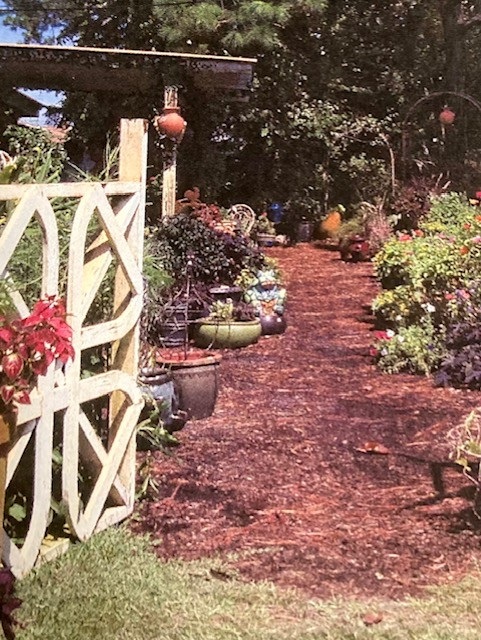
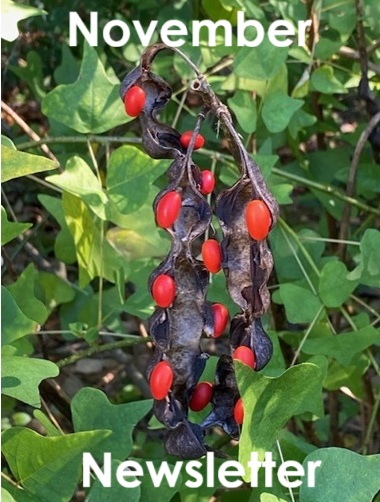
The shift to cooler temperatures in the last few days has brought some changes to the garden. Many flowers are fading; the insect population is much less active; migrating birds are arriving, looking for food. And it is definitely a change for the gardeners! It is lovely to be in the garden in the cooler, drier air.
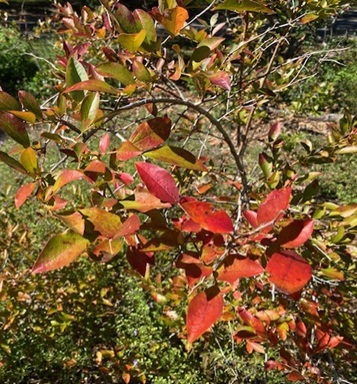
We are beginning to get fall color other than from flowers. Sweet gums, maples, and blueberries, are changing color to reds, oranges, and yellows. Grapevine and Virginia creeper are lighting up the woods with bright red and glowing yellow.
I picked (and ate) my first satsuma of the season, and my grapefruit is ripening. My mother made a grapefruit and avocado salad that was delicious! But I can’t remember the recipe! I’ve been experimenting with my grapefruit as it ripens, using grapefruit sections and avocado on a bed of spinach — but what was the dressing?? My favorite so far is fresh squeezed grapefruit juice, 1/2 tsp of honey, a sprinkle of ground ginger, and a sprinkle of garlic powder. Yummy! (You cooks out there might have to experiment with amounts needed.) Don’t forget our citrus recipes.
There are still fall flowers blooming. One of the most spectacular is Sky vine (Thunbergis grandiflora). This vine literally can climb skyward to the top of a mature pine tree — which it did at The Garden Gate. (Unfortunately, it was the neighbors’ pine tree!) The large blue flowers are mostly toward the top of the vine — often you have to see them from a distance, or at least look up. Sky vine dies back in the winter but reemerges in the spring.
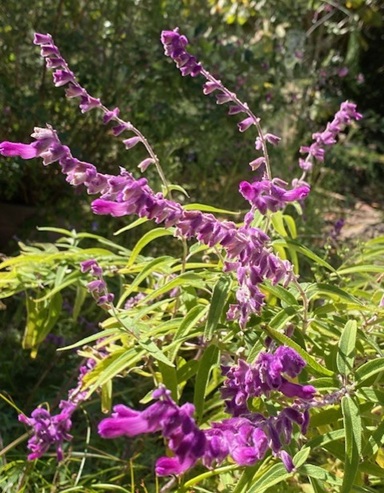
Mexican sage (Salvia leucanthemum) has silvery leaves and long stalks of purple flowers. This shrubby salvia grows to a height of about 2’. Mexican sage loves a sunny, well drained garden. Lion’s ear (Leonotis leonurus) is reaching full bloom with bright orange stacked flowers. Dune sunflower will continue to bloom until cold weather or a freeze knocks it back. Mexican sage and Lion’s ear will die back in the winter, but regrow in the spring. Dune sunflower will die in a frost but reseeds everywhere!
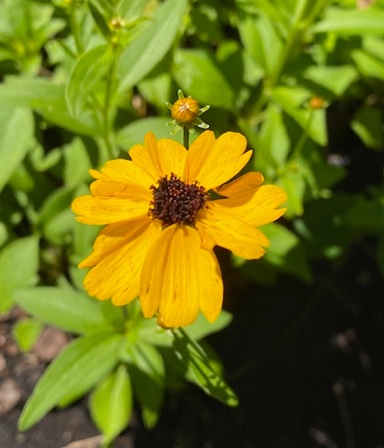
Chipola coreopsis (Coreopsis integrafolia) is a native coreopsis that blooms now, and in the spring as well. A yellow daisy bloom on a 1’ tall plant, Chippola coreopsis spreads from the root to make a large drift. This tough plant grows in moist or irrigated soil, in sun to part shade.
The bright yellow flowers of fall Cassia (Senna bicapsillaris) are some of the showiest of all! This cassia can grow 8’ H x 8’ W. It is also a host plant for the sulpher butterflies. There are several local species of sulphers, ranging from the large cloudless sulpher – a large bright yellow butterfly — to the sleepy orange, a small pale orange butterfly. The female butterfly will lay elongated eggs on the very newest leaf of the cassia, or host plant, so that the newly hatched caterpillar will have the freshest food. These caterpillars look exactly like the vein of the leaf they are on, giving them great camouflage. They are very hard to spot! In the very last molt, the caterpillars are then striped with blue or black stripes. Sulphers have native host plants, including the partridge pea (Chamaecrista fasciculata), a re-seeding annual. Partridge peas grow in sun to part shade.
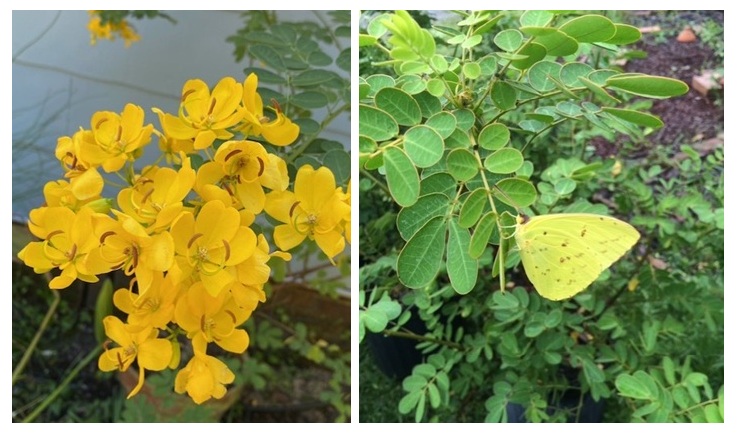
Other butterflies are laying eggs in the last of the summer heat. I watched a pipe vine swallowtail lay her eggs yesterday. The selection process to get just the right leaf is lengthy. The female tastes the plant with her feet, landing and lifting until she finds the perfect leaf. The pipe vine swallowtail is one of the few species in our area that lay eggs in groups instead of singly. The female will lay about a dozen orange eggs in a cluster. When the caterpillars hatch, they will remain in a group for about the first week, then begin to forage the plant singly.
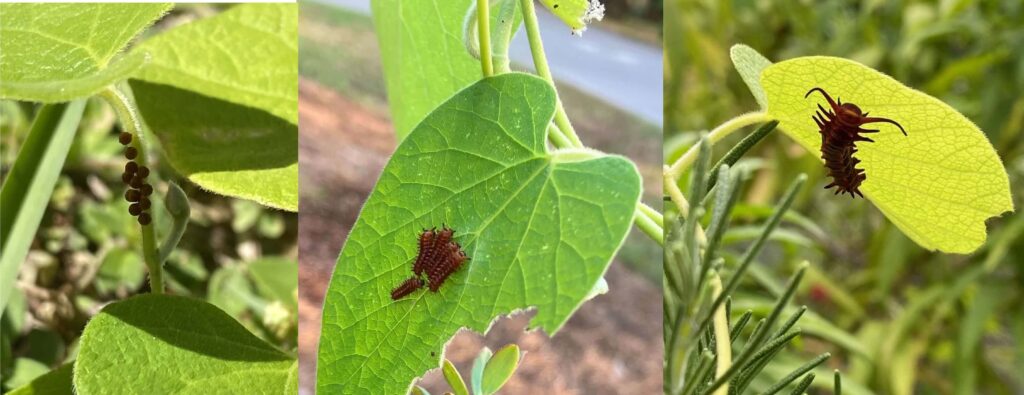
I love these ugly caterpillars! They are a dark brown to black color with spiky orange spines and bumps — very alien looking, but harmless! Like all swallowtails, they have impressive defense mechanisms. They rear back to look threatening, raise two horn-like appendages (called osmeteria) and spit out an awful smelling liquid. None of this is truly harmful, but it certainly makes people and other species back off.
Their eggs, however, are fair game for predators. Ants, paper wasps, and other predators will often take butterfly eggs back to a nest to feed their young. Like we would take home eggs from the grocery store, the butterfly eggs are encapsulated food for the family. The amazing thing is the balance in these connections.
All of our insects are preparing for winter. Most butterflies and moths will overwinter in cocoons or chrysalis, so that the next generation will emerge in the warm weather of spring. Monarchs will migrate to warmer Mexico. Many bees will overwinter underground or in hives, or protected larval tubes. Insect activity drops drastically in cooler weather. On warm and sunny winter days, we will see some insects emerge, but nothing like we see in the heat of the year.
Flowers are far fewer in cooler weather, because there are fewer insects to pollinate them. Flowering plants put their energy into seed production. This is the time of year for seed dispersal. Seeds have developed some amazing ways to disperse! There are “spiky” seeds that stick onto whoever or whatever passes close by. Think sand-spurs or Spanish needles (the common name for Bidens alba). There are “sticky” seeds, like dichondra and certain wild legumes come to mind — their seeds stick to clothing and pet fur. Other seeds are wind-blown, or fall close to the source. Some are carried by birds and mammals, such as squirrels.
Sometimes the squirrels are the “go-between. My 6’ tall Mexican sunflower (Tithonus) has dropped all of its bright orange petals, and is going to seed. After a summer of prolific flowering, the petals have dropped. The center of the flower that holds the seeds has turned brown and dry, its job is done. Like so many of the flowering plants in my garden, the Mexican sunflower awaits seed dispersal.
The squirrels are working hard at pulling off the seed pod. They don’t seem to be eating the seeds — just carrying the seed head off, or chewing the pods until the seeds fall on top of the fence. At that point, the birds land on the fence and eat the seeds. And the squirrels head out to do another inexplicable “squirrel thing”. (Does anyone reading this newsletter have strong opinions about squirrels?? Never mind! I know the answer to that question!)
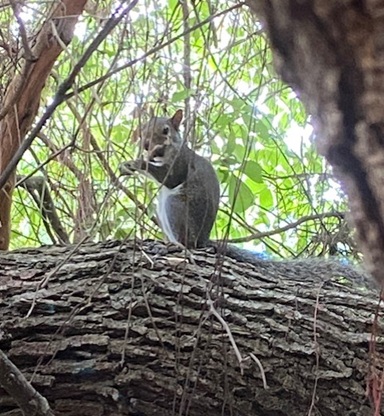
Squirrels are preparing their nests for winter right now by adding vegetation for extra warmth. For several years, a dog grooming business operated next-door to The Garden Gate. We shared a dumpster with that business. I remember standing under a large pine tree looking up and seeing what looked like a poodle about 25 feet high on a limb. It was, of course, a squirrel nest. The squirrels had collected dog fur out of the dumpster to make their nest more cozy.
Often under our magnolia or other evergreen trees, there will be short stems (1′ or less) with leaves, littering the ground. If a squirrel breaks off a stem to use in the nest but happens to drop it, they don’t climb down and pick it up— they just chew off another stem. I don’t know how many stems they need for their nests, but they certainly drop a lot of them. Perhaps that is nature’s way of adding mulch, but I think it is another curious squirrel behavior.
This is a good time to collect the seeds of flowering plants. Whether you are collecting weed seeds to prevent germination in next year’s garden, or collecting seeds that you want to grow next year, collecting the seeds before they are naturally dispersed lets you guide the process. This is where “thoughtful” gardening comes to mind. Is the seed important as a food source for birds or other wildlife? Is the plant that produced the seed a host for other species like butterflies? If the plant and seeds are removed, how will the ecosystem be impacted?
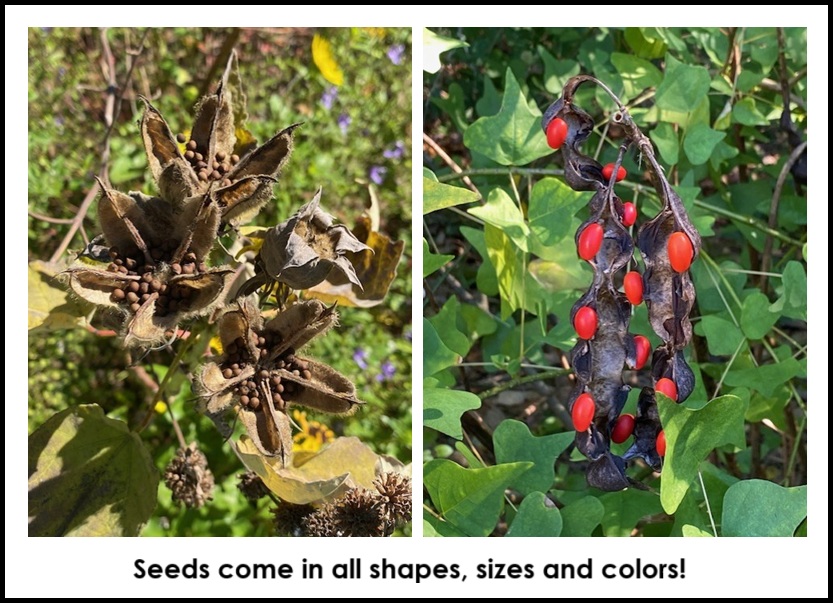
Seeds play more than one role in nature. Often I think of a seed as a “plant pregnancy” — but seeds are also a food source for many other species: birds, mammals, some insects, and people. One of the most important roles that seeds play has to do with keeping soil alive.
A fallow area, where nothing grows (or is allowed to grow), has literally “dead soil”. It no longer holds nutrients, roots, or living organisms that channel air and water up and down, no longer support plants or animals. It is fallow. Usually, in our gardens, seeds will sprout the minute the soil is cleared of top vegetation (often considered weeds!). If seeds are not permitted to sprout and grow, the organic material in the soil will eventually dissipate, the living organisms will die.
The process of bringing life back from fallow soil starts will rootless plants — lichens and mosses. These plants take up water and nutrients from the air. As the mosses and lichens age, die and decompose, other plants and organisms will feed on the composted remains. Often grasses will seed in this compost. Grasses serve two purposes (at least). Their root systems are fibrous and thick to hold soil in place. The blades or foliage catches soil that blows around, adding new soil. The exchange of air and water begins and the soil comes back to life. As the seeds of herbaceous plants are dispersed, they will catch in the grasses, fall to the ground and germinate. The last layer will be trees and shrubs. These important plants bring air and water deeper and higher, and cool the soil. This remarkable process feeds us all.
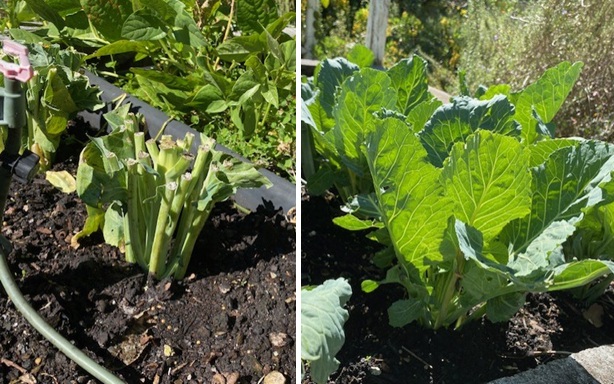
This process will be feeding me — I’ve planted several types of lettuce, arugula, carrots and spinach seeds in the veggie garden, and most all are germinated. I take a shortcut with collards and some head lettuces. When I buy these greens, I cut the leaves to use, but plant the stems. This is a quicker process than seed germination! The compost that I added to the vegetable beds was full of tomato seeds, so I have tomato plants coming up too. Many people wouldn’t have thought of sowing tomato seeds this time of year. Nature and the tomatoes know best!
Successful seed starting doesn’t always mean following the directions on a seed packet. These instructions are general, applying usually to the center of the country. The growing conditions for our area are unique: our temperature, moisture, and soil composition play a role in when we start seeds. Often the best directions for seed selection will come from someone who gardens here. The local extension service can give you local advice. But sometimes it is fun to experiment with seeds. (See our Seed Starting Guidelines)
Seed starting is one of the most “hopeful” actions available. About a week after Hurricane Ivan devastated our area, several Garden Gate employees gathered in shock at the devastation. All of our homes had been damaged: some flooded, one completely destroyed. At the shop the fences were down, the plants were up-ended, a huge sycamore tree was down. We wandered out to what was left of the greenhouse, and began to plant seeds and take cuttings. Something about starting seeds made us all feel lighter, ready to move through the mess around us and look toward the spring.
Starting seeds with children is also like making a miracle together. Hands in the dirt, planting the seeds, then the amazing plant that emerges. That process makes us “partners” with nature. There are other “hands-on” ways to do things with kids and grandkids in the garden. Just walking around the garden or neighborhood exploring is a great experience. Drying flowers, crafting with natural materials, creating fairy gardens, drying herbs and cooking with them — the list is endless! (See instructions for fast flower drying here.)
One of our customers shared her experience of making “memory baskets” with her grandchildren. They would take a walk together, collecting anything natural that caught their attention: flowers, mosses, seeds or cones, interesting bark or sticks. When they returned home, these items would be glued and attached, or placed in the basket as a memory of the walk. Of course, this is fun with friends, too!
I am excited about the Campus Gardens Tour on Nov. 15th. We will tour two gardens on the campus of UWF, and we will be guided by the faculty and staff that envisioned these gardens. Both of these gardens are inspiring. The Community Garden is large, multi-faceted, and still growing. From an empty field to a garden that includes a vegetable garden, fruiting trees, a tea garden, a pollinator garden, and beds of native plants, this garden demonstrates many ways to garden. The Heritage Roots Garden at the Archaeology Institute on campus demonstrates many of the ways people used plants throughout our history: for food, medicine, and building and crafting. These gardens hold both our potential and history. To join in, please RSVP on the event page.
Happy Thanksgiving to you all!



Leave a Reply to Anne Geisel Cancel reply