I began writing this on Feb 1st (2-1) and the temperature outside matched the date — it was 21 degrees! This current freeze is even colder than the freeze we experienced a week ago. This weather is forecast to last three days with temperatures below freezing at night. I always groan and feel sorry for myself when a freeze is predicted—I have to move plants and cover plants, protect and drip faucets, etc. — all the things that living in Florida is supposed to prevent!
Actually, one of the most amazing experiences of my life occurred during a hard freeze at the end of 1984 (it got down to 8 degrees!). I lived on East Bay, which is very shallow close to shore in most places. When a north wind of a cold front blows, it will push the bay water to the south — just as hurricane winds will build up a surge of water from the direction it is moving. The wind made the water even more shallow than usual. The shallow water froze from the shore to about 100’ out. That was amazing to see!
Many fish (mostly mullet, bottom feeders usually found in shallow water to feed) washed up on the shore in amazing numbers. The beach was covered with dead fish, so for about three days, my family and our neighbors dined on fried fish. After that, I “planted” them in the vegetable garden. Using a post-hole digger, I dug holes about 18” deep about every two feet in the vegetable garden. I had amazing gardens for at least five years from that “gift” of the freeze.
But the truly amazing experience was to discover unsuspected sea life — tiny crabs and shrimp species I had never seen before (they were too small or too hidden) and other interesting creatures that lived in the sand. Most were shellfish of some kind, but there were tube worms living in the sand, too. They had their protective ”tubes”. When the water receded or froze, there was no access to oxygen for these creatures. They made their way to the surface where they “froze” — for a while. A neighbor and I warmed a large bowl of frozen bay water. When we put the frozen sea life in the water, they all came back to life! It is truly amazing how all living things have the ability to adapt to life-threatening events.
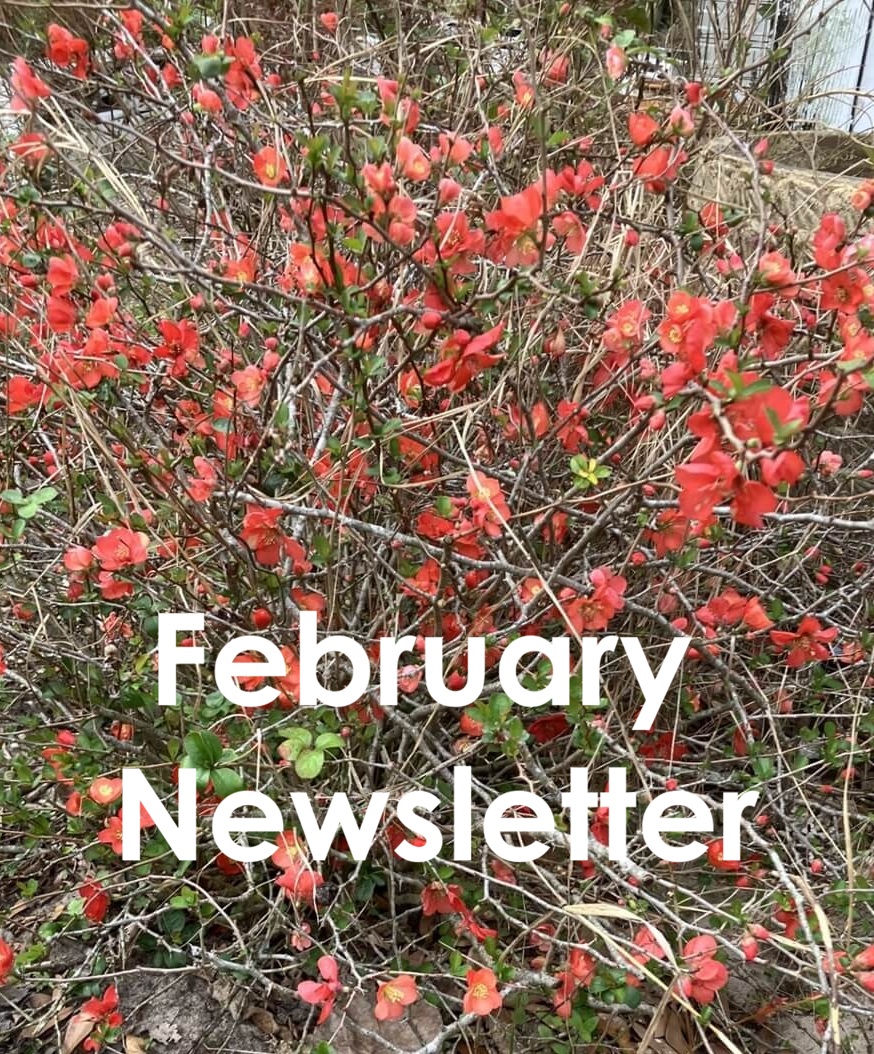
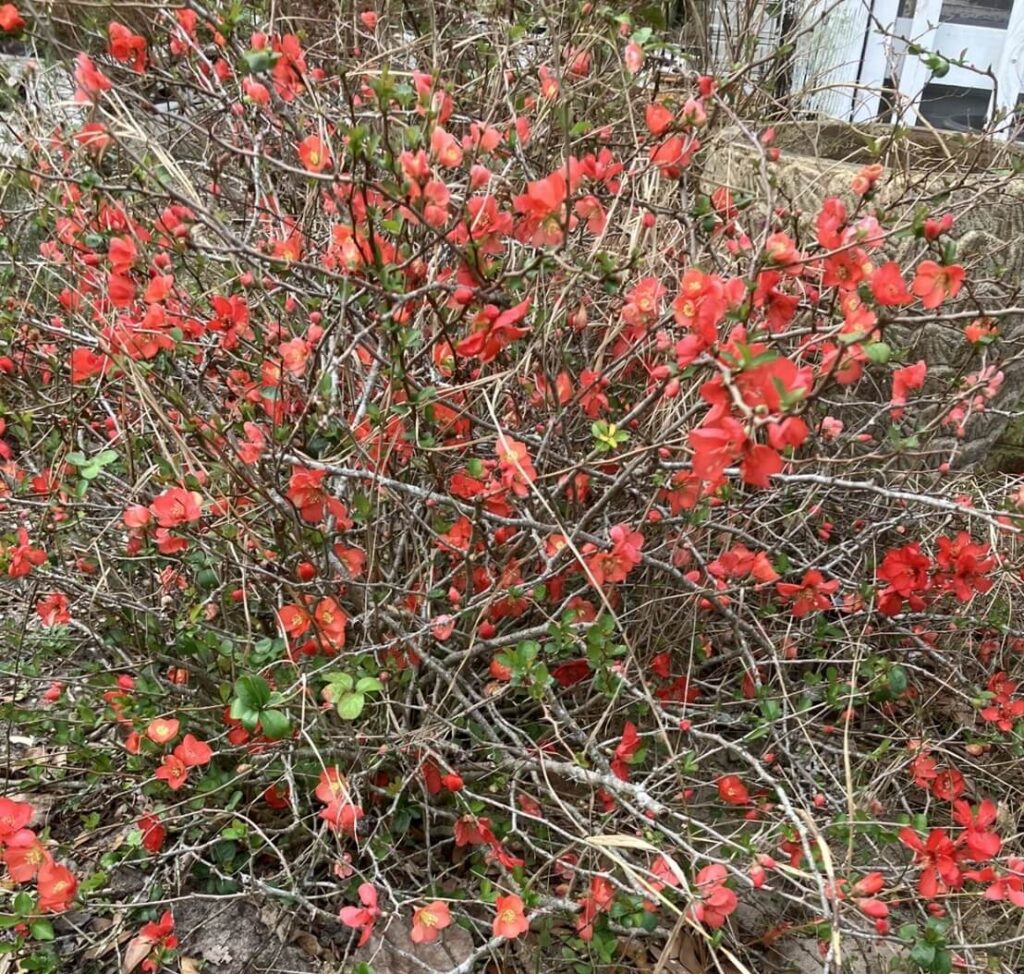
There is one shrub that went through the freeze covered in blooms. The dwarf quince blooms in the winter after it has dropped its leaves for the season. I have been growing this plant for almost 20 years, and I have a love-hate relationship with it. The beautiful, bountiful coral blooms light up an otherwise dull bed in the winter. But quince are very thorny plants! Keeping this plant trimmed back from the path always is prickly, to say the least. I never come out unscathed. But I will continue to grow it for the beautiful winter blooms. I never notice pollinators on the quince — not many insects are active when it is blooming. Hummingbirds visit these flowers, so I suspect they are the pollinators. The plant does produce fruit, in case you are brave enough to reach trough the thorns to pick it!
For the plants in our gardens, adaptations to freezing temperatures include leaf drop and die back, but that doesn’t always man the plant is dead. Before you cut back or remove trees and shrubs, do the “twig test”. If a twig or branch is supple when slightly bent, it is alive and will most likely re-leaf in warm weather. If the twig snaps, it is dead and can be cut back. Many woody plants, however, will lose the branch tips but the lower stems will be alive. Continue the twig test lower on the stem to see if the lower branches might be supple. It is a good idea to leave the tree or shrub intact until the weather has been warm for a while.
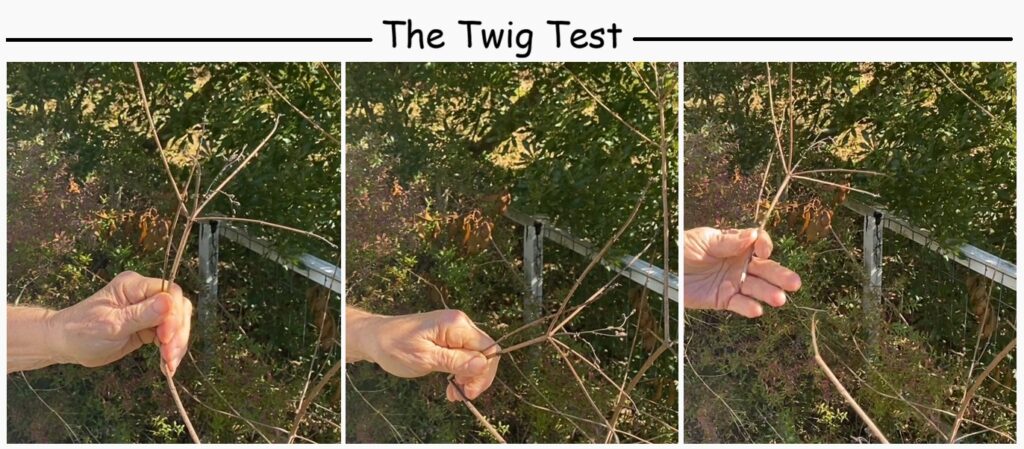
Keep an eye on our Facebook page for a short video reel with the twig test!
Some of our usually hardy shrubs will die back to the root, then re-emerge from the root system when the weather is consistently warm. Bottlebrush is a good example of this. This popular upright shrub has been a staple in our area for many years. Usually evergreen, it can reach a height of 10’ or more. The red blooms are present in warm weather, and do resemble a bottle brush. (Hummingbirds love these plants.) Several years ago, a hard freeze killed the top of many bottlebrush shrubs. Some people cut them down, only to discover in late spring, when the shrubs began to emerge from the root system, that bottlebrush have a strong will to live! The roots were alive and well. The moral of this story is patience — waiting to see if the plant will leaf out in warm weather. (I don’t know about you, but my patience level is usually low!!)
Early pruning may be a potential mistake for other reasons. Pruning signals a plant to put out new foliage, which is exactly what we want. In nature, putting out new foliage is signaled by warm weather. Re-leafing in winter months often requires a lot of energy for a plant. Plants often use fall and winter as a time to grow roots and/or store energy for spring. If another freeze should come along, the process will be repeated, stressing the plant’s energy and resilience. Sometimes the plant might die, but if it lives, the plant might be more susceptible to pest and diseases, or just not as healthy. For best results, wait to prune until all danger of freeze has passed.
Our natural instinct with a “sickly”-looking plant is to feed it. (Food is love?) And plants often look “sickly” after a freeze. But over fertilization, or fertilizing at the wrong time can also stress a plant by forcing it to grow unnaturally, using up energy meant for other seasons. Just like over-fed people, there are health consequences.
Most gardeners are familiar with the “cold-hardiness” zones. This map divides the United States into average low temperature zones. It is often used on seed packets, for example, to give us information about the probable success of planting the seeds in our zone. We are in zone 9. Our average coldest temperature ranges from 20 to 30 degrees. (This map gives information about cold temperatures only. Other growing conditions, such as heat, humidity, soil and water are not included in the zone information.)
For flowering plants (annuals and perennials), information about the natural cycle of plant growth relative to season and temperature helps us choose healthy plants. For annuals, cold weather responses usually depend on the origins of the plants. Our winters are usually a lot like Alaskan summers. These plants are mostly cold hardy for us and bloom through our winters. Pansies and snap dragons, nemesia and diascia are examples. (If you visit Alaska in August you will see beautiful baskets of these plants, and they will be HUGE! These plants grow to a larger size in Alaska because the days are longer in their summers, giving the plants more light. The extra sunlight gives the pollinators more heat to do their job, too. Their days are longer but their summer are shorter.
Perennials also match their place of origin, so they may keep growing, or they may die back. Perennials are classified as “hardy”, “tender”, or “tropical” in the nursery industry. “Hardy” means they will live through extreme cold weather, and even if they die back, they will re-emerge in the spring. ”Tropical” means the plant most likely can’t survive a freeze. “Tender” means the plant might tolerate a light freeze for a short period. An example of a “tender” perennial is our native red sage (Salvia coccinea) that survives cold weather but dies in freezing temperatures. However, we can count on our red sage to reseed!
When a freeze or colder temperatures cause a perennial to die back to the root, the dead foliage may be cut off. But that may also trigger a growth spurt to leaf back out before the weather is truly warm, potentially stressing the plant. Early spring and fall are the best times to divide perennials to increase their number in your garden.
A little late for this freeze, but there are things you can do to help your plants better survive cold weather. One is covering them with frost cloth — a fabric that lets light and water through but gives frost protection up to about 8 degrees above the outdoor temperature. (The frost cloth works the best because it “breathes”, whereas plastic can prevent the needed exchange of air.) One of the best things you can do to protect your plants is to mulch. Mulch of fallen leaves is actually the way that nature keeps the soil warm. Warm soil keeps roots warm so the “above-ground” plant can continue to take up water and nutrients. “Living” soil provides protection for ground-dwelling animals that play such a crucial role in the health of above-ground living plants and animals.
Nature grows in layers. The layers are protection and connection for living creatures — air, water (above and below), and soil (above and below) — by providing habitat. Mulch is a natural layer. In a natural wooded area, leaves that fall from the trees provide warmth and protection for the soil, food for many organisms that turn the mulch into compost, and habitat for varied wildlife. AND mulch provides weed protection by preventing weed seeds from germinating!
The layers in nature were brought to my attention by my grandson when he was in elementary school. We were on the Canopy Walk at the Atlanta Botanical Gardens, and Ben kept asking me “Grandmom, what’s this bug?”. He asked again and again during the walk, when he spied an unfamiliar insect. I was surprised that they were all unfamiliar to me as well —because I am familiar with a lot of insects! That’s when I realized that the insects that populate the canopy layer are different from the insects seen at ground level. Once I realized that, I started to see the layers more clearly.
Here is an example from my own yard: In the cooler weather, the ground-dwelling worms and insects go deeper, making it harder for the birds that feed on them to unearth. When I am in the nursery area, filling pots and moving old potting soil, or moving mulch, the brown thrashers show up for a free meal. The thrashers chirp and fuss at us to find a worm for them. Thrashers are amazing mulch-movers, swinging their beaks back and forth until a worm or insect is uncovered. But their food source has moved deeper into the soil in cold weather. These birds are aware that we gardeners will be turning soil, and they’re usually very vocal, urging us to uncover a worm or bug. Thrashers recognize that humans can be a “tool” for food.
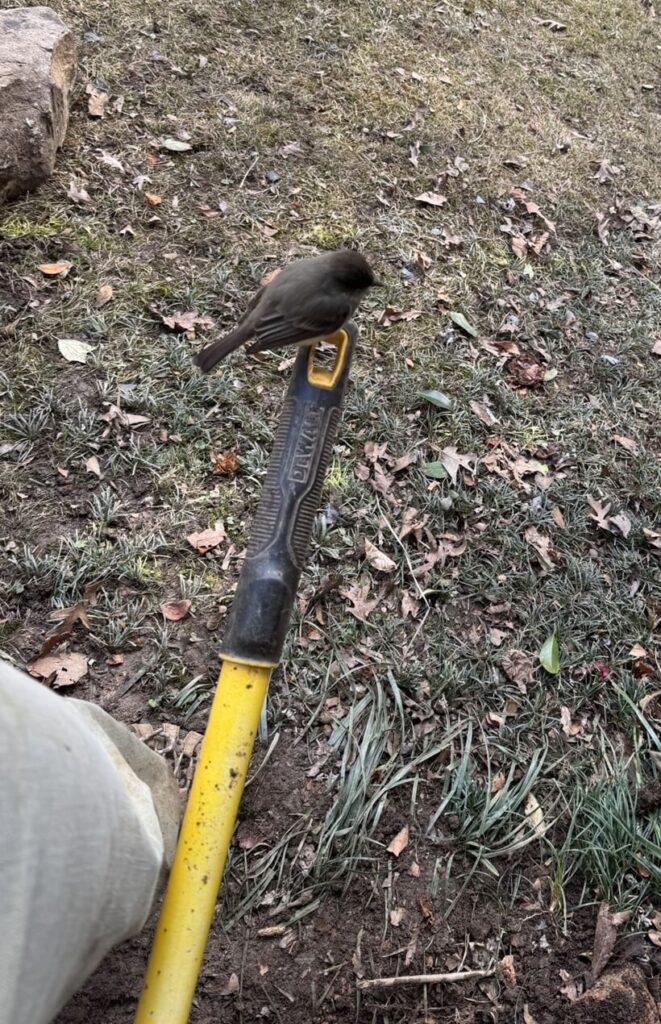
Thrashers aren’t the only bird species to look to humans for food. In Atlanta, a phoebe watches from a shovel, while my daughter works in a garden. Several times the bird landed on her shoulder. The phoebe, not so patiently, is waiting for a worm to be uncovered.
Depending on weather, flocks of robins will move through our area this month. On their return trip to more northern territories, they will stop to feed on cherry laurel seeds, insects and worms. (Can’t you imagine two robins huddled on a branch, one saying, “Martha, this isn’t what we came to Florida for!!”)
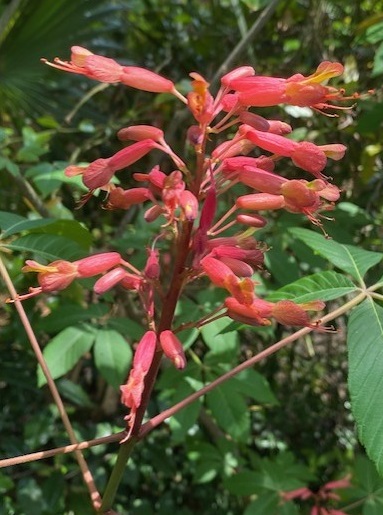
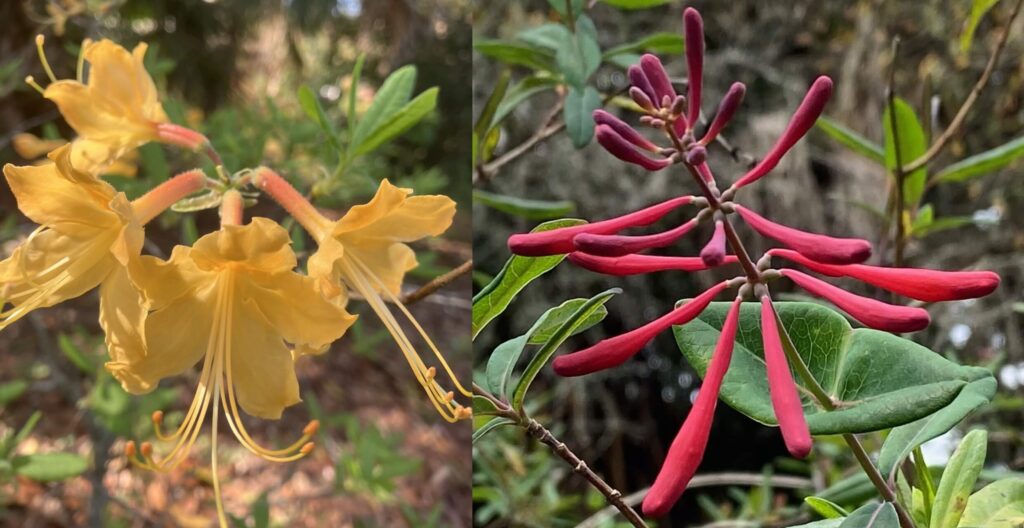
Hummingbirds will arrive later in the month. One of the hummingbird favorites, the red buckeye tree, will be the first to bloom, with stacked red bloom late this month and into March. Buckeyes are the first to bloom, and also the first to lose their leaves in the fall. Buckeyes are happiest in the shade and usually grow wide rather than tall. Then come the native azaleas, and the coral honeysuckle are also early food sources for them. There is still time to plant these woody plants to attract these fascinating birds. As soon as the temperature is consistently around 65 degrees, early bees will emerge to pollinate the early blooming plants.
Meanwhile, back on the farm (so to speak!) — the collards are holding their own in the freezing temperature, as is the kale. Some herbs are protected with covers, notably the basil and culentro, but the others are doing great. Feb. 15th is the traditional time to pant seed potatoes in our area. Be sure to use certified seed potatoes to prevent disease. These are available at local farm and garden stores. Cut the potatoes into chunks with at least two “eyes” on them, and plant about four inches deep. Nothing tastes quite as good as a freshly dug potato! And it is pretty thrilling to reach down in the dirt, feel a potato, and pull it up! Children especially are amazed at finding this food underground instead of in the grocery store.
Gardening with children is one of the best activities for both adults and children, because it is “hands-on”. Actually, gardening with friends is satisfying on many levels. I am fortunate that I got to garden with my children (and still do occasionally!) and with my grandchildren.
“Hands-on” activities of almost every kind give us an experience that adds depth and presence to connect with nature, or other people. I also got to garden with friends at The Garden Gate. We had so much fun and laughter, and sometimes tears or anger. But being in the garden with our hands in the dirt and friends at our side made everything ok. The hard work of covering plants for a freeze, the monotony of weeding or potting was worthwhile sharing conversation with friends. How much I learned about gardening from friends and customers! And if you are reading this newsletter, you are learning from the experience of other gardeners. These days, friends that volunteered with me in the gardens get together for a “pot party” — time spent potting plants or working in the nursery together. I’m grateful for their help, but I love their conversation and companionship. And then we eat! (0r over-fertilize?) Sharing your garden makes for life-long friendships.
We will be giving a presentation on propagation for the Hoe and Hum Garden Club on Wed. Feb. 11, at 10 AM. This will be held at the Gulf Breeze Senior Center at St Francis Church. Everyone is welcome. — Please join us! This will be a hands-on opportunity — we will be starting seeds for everyone to take home.
It is now Feb. 6th, five days after I started writing this newsletter. I just wandered outside, where the temperature is 62. Cool and breezy in the shade, but lovely in the sun with blue, blue skies. In just this short time, buds are popping out on deciduous plants, and I even saw a sulpher butterfly searching for nectar. Spring is on the way!



Leave a Reply to Barbara Albrecht Cancel reply