I hope that everyone is safe, and suffered little or no damage from the hurricane. I apologize for the tardiness of this newsletter. I began this newsletter in the last few days of September, writing: “How lovely to experience cooler days and nights at the end of September.” Then, BLAMO! Over 8” of rain fell! On the second start I wrote: “October brought rain — maybe a little too much, too long.” Then BLAMO! Hurricane Isaias hit! Everything that I had planned to write about October and the “gifts” that arrive this month was changed.
What a surprising hurricane Isaias was — the steady winds from the north, the straight path at a speed that didn’t waver much, and of course, the timing in October was unusual. Fortunately, my house is fine. But my Pensacola neighborhood has an astonishing amount of trees down and damaged. This is true for the entire path of Isaias. Old trees, some that have lived for a century or more, fell. Across the street, two oaks with a tremendous girth came down. Most of the fallen oak trees seem to be water oaks, a tree with large lateral roots but no tap root. More live oaks, that have a wide root system and a tap root, are still standing. I suspect that the heavy deluge of rain the week before may have contributed to the loss of trees. The contrast between the time it takes to repair or replace structural damage is minimal when compared to the time it takes a tree to mature. But we can plant anyway!
After every hurricane I have experienced since moving here in 1970, people have come together to help each other in hands-on ways: feeding, cleaning, transporting, rebuilding, healing. Over the decades of my life along the Gulf Coast, seven hurricanes stand out in my memory. Hurricane Ivan brought the worst destruction— our house was flooded, beach washed away, garden inundated. It took months to repair. The Garden Gate was in shambles. All the plants were turned over, the fences were down, there was no water or power.
But people from the neighborhood, friends, and customers came to help. We gathered there to share our stories of the disaster: homes damaged or destroyed, the power of the wind and the water, the near and dear that made it through. In the greenhouse, we started seeds – a hands-on experience of starting new life. Nature is reciprocal, and because we are nature too, we naturally want to support and share.
Nature (and a garden) is always in a process of change… sometimes surprising change. Even in hurricanes and their aftermath, we can receive amazing natural sights! The night after the storm passed, the sky was clear. And because there was no power, there were no street lights. I got to see the stars in all their glory and multitude. What a gift and a grace!
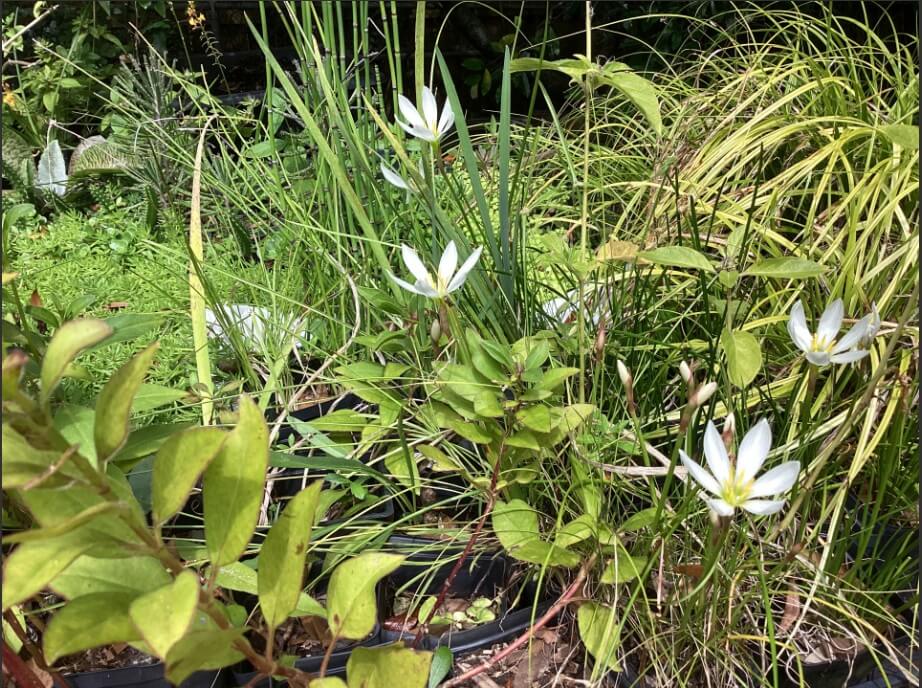
Nature is adaptable. Another gift was what a friend called “a bird bonanza” — migrating birds dropped down in flocks to avoid the hurricane winds. Warblers and finches, plus the “home birds” sheltered in place. When the winds subsided, these birds were hungry! The beauty berry has very few berries left, and other food sources were consumed. My pond and birdbaths supplied water. Many of the migrators have moved on, but a bright red tanager greeted me this morning.
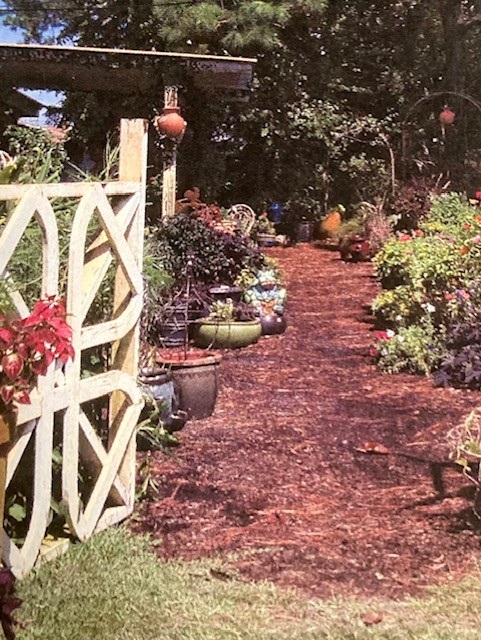
My garden is “young” compared to others in my area— it has been planted over the past nine years. Over those nine years, my front yard, which is planted with mostly native trees, shrubs, and perennials has filled in and become a habitat. The red cedar grew from a small 3-gallon plant into 12’ H x 10’ W. This tree is a favorite of the birds for shelter. Its thick foliage houses many species, especially the thrashers. A lower limb of the cedar split off in the storm. I am hoping it will recover.
My longleaf pine (most of you know her name is Bev, named after a famous hula dancer) is leaning after the storm, but she is still in place. Bev was bent almost all the way to the ground in hurricane Sally, when she was about 5’ tall. We staked her back up, and she has grown to over 20’ in the years since. I’m not sure we can stake her up this time.
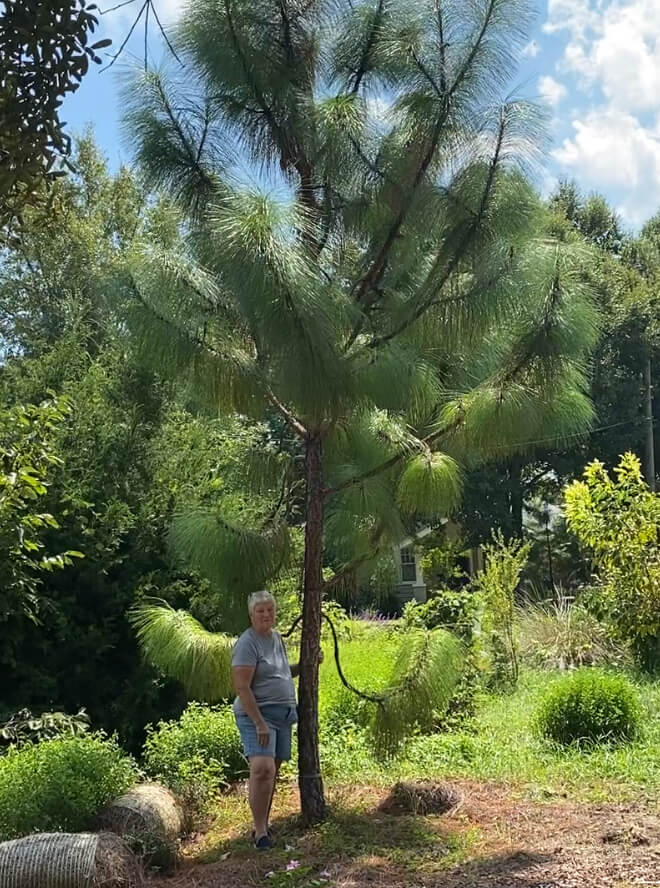
Bev has grown from a 3-gallon tree with no trunk (looked like grass) into 20’ plus in 9 years. Trees usually grow faster if they are small when planted. It takes less effort to get the root system out to stabilize the tree and support new growth. Once the roots are set, top growth will take off.
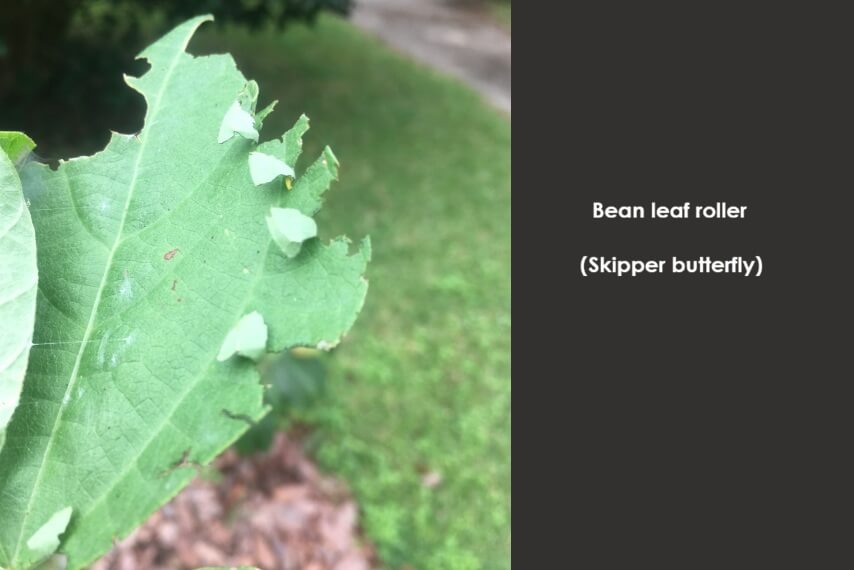
Since being planted, my “young” front garden has become a “habitat” for many birds, pollinators and other insects, small mammals, as well as lizards, frogs, and turtles. Just after the storm, there was not only a bird bonanza, but wildlife of all kinds came out of shelter. Blue jays are doing some ritual dances, whether they are declaring territory or looking for a mate. Hummers are darting back and forth to find the flowers. Butterflies are flying too, after sheltering through the storm. I’m seeing several species of swallowtails, sulphers, fritillaries, and lots of little butterflies. The long-tailed skippers — also called “bean leaf rollers” are evident on the beans and pea leaves in the garden. My large cassia blew frantically from sky to ground. I found a displaced sulpher caterpillar that had landed on a pipevine from the swinging cassia. And the dragonflies!! Look up around dusk, and there are dragonflies darting quickly, catching mosquitos and other small insects.
Hummers, butterflies, and bees are feeding on the salvias blooming now. Forsythia sage (Salvia madrensis), one of the largest salvias, grows to 4’ and makes a large clump that can be divided. The yellow blooms can be 12” long, and are very showy. Add in the native red sage (Salvia coccinea), the blue Indigo Spires salvia, (Salvia x Indigo Spires), which reaches 3’ wide, and there is a mass of blooms and many pollinators.
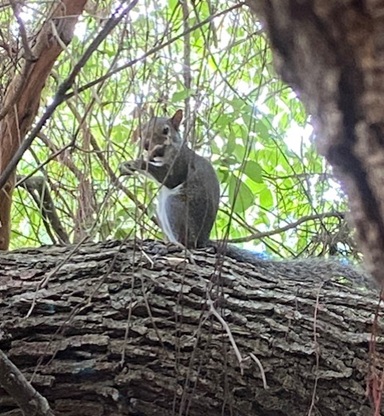
Squirrels are on the look-out for nesting materials right now. In addition to the mess left by Hurricane Isaias, squirrels are chewing short limbs from trees and shrubs to use for nesting materials. They are very likely to drop the stems, however. The squirrels don’t go back and pick up the stems they drop… they just go back to the tree and cut another one, leaving a pile of dropped stems. I caught them cutting and dropping wax myrtle stems — there is a pretty big pile under my wax myrtle!
Hurricanes (especially this one!) bring an amazing amount of “yard trash”. Most of us have debris picked up by county or city services. I have some large piles by the street. This also can be a gift. Another way to think of this debris is “yard hash” — a food source for nature — the trees, and other plants, the wildlife, and the soil.
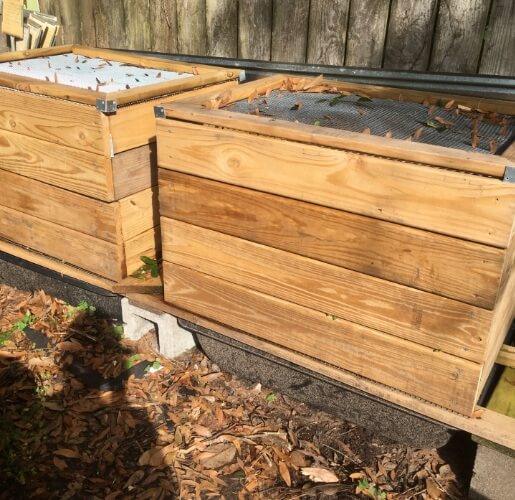
I have a “compost pile” (actually compost boxes) where I put kitchen waste. This compost needs to be covered to eliminate the odors that draw unwanted wildlife and offend people. This process makes a rich, moisture-holding compost that I use in my vegetable garden every season.
A “habitat pile” differs from a “compost pile” since it usually has no structure, but is simply a place where yard trash is deposited. Sticks and twigs, logs and leaves stack up. And before you know it, the earthworms and the insects that digest plants arrive to the banquet. Then come the birds, the turtles, and the lizards that eat the worms and insects. A habitat pile can be small, and tucked out of sight. But a habitat pile will feed an entire ecosystem. It is surprising how quickly habitat piles are found by wildlife and how quickly the bird populations build in your yard.
October brings other clean-up chores. Some pruning may be needed, and before planting for fall, summer veggies and other plants must be removed. All of this “on-going” yard hash can contribute to the health of your garden if composted. Compost and habitat piles can take up a very small space.
Don’t prune hydrangeas or azaleas this time of year. Their flower buds for next spring are already set, even though they might not be visible. Summer is the pruning time for early spring blooming shrubs. If these plants are cut back now, they will not be able to bloom next year.
October is a good time to plant trees. It may seem strange to recommend planting trees a day or two after a hurricane, but trees do so much for all living things. They provide oxygen for people and animals, and carbon-dioxide. They regulate water drainage by slowing and absorbing excess rain. Tree roots keep air moving through the soil, providing life underground to support us all. Trees are temperature regulators for soil, keeping it “alive” — neither too hot nor too cold for the organisms that live in it. Trees provide food and shelter for all the living creatures in an ecosystem. We are “partners” with the plants and animals in our gardens. My “young” garden has demonstrated to me newly planted woodlands grow much more quickly than I expected.
A wooded garden can fit in a corner, or an out-of-the way spot of your yard. In fact, almost anyone can have a wooded garden, or at least one tree. If you have room for a bench and a birdbath, one tree and some small shrubs can become a place of privacy, serenity, and habitat. The size of the space is less important than the layers that are planted. Tree, shrubs, perennials, grasses, ground covers — all of these provide food and shelter. Any wooded garden can become a habitat garden – a safe space for people and wildlife. And you don’t even need a bird feeder!
These habitat areas need not be messy (this is a thought I hear from many gardeners). Simplicity is the key. As little as three species, if used in a cohesive design, can become a beautiful habitat for people and wildlife.
In October we begin to get cooler temperatures, less humidity, shorter days. It is the time to remove the summer veggies and plant for fall — greens and lettuce, spinach and kale, carrots and turnips are grown in winter. Winter herbs are cilantro and dill.
October brings our “fall color”. Instead of trees, our fall color comes from roadside wildflowers, and there are a lot! Several species of goldenrod (Solidago ssp.) bloom in our area, with bright yellow coloring fields and roadsides. (Goldenrods are often blamed for allergies, but their pollen is too large to enter human noses — ragweed is the true culprit).
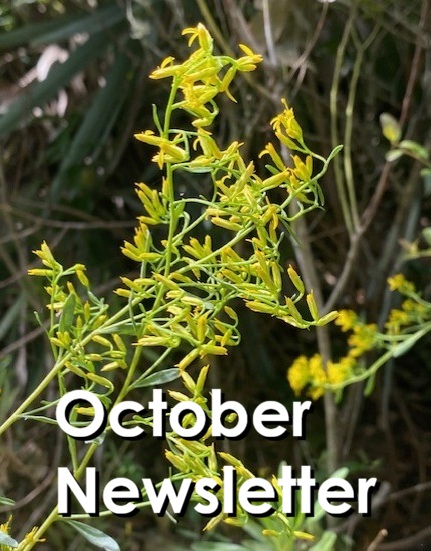
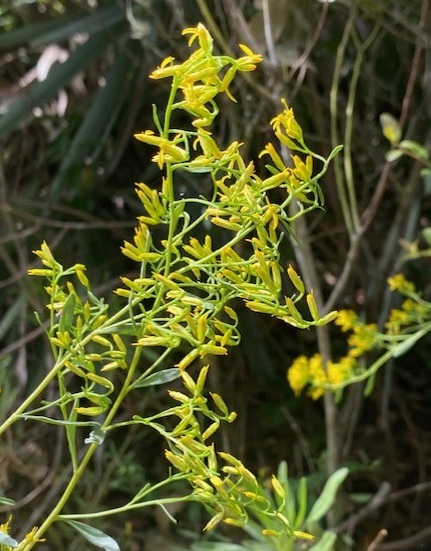
My favorite “goldenrod” is not a goldenrod at all, but produces lots of flowers this time of year along the roadside in Gulf Breeze and on the beach. The common name is Woody Goldenrod, but the genus is Chrysoma rather than Solidago. Woody goldenrod is a small shrub rather than a perennial. The blue-green foliage is evergreen, and it grows profusely in my East Hill garden.
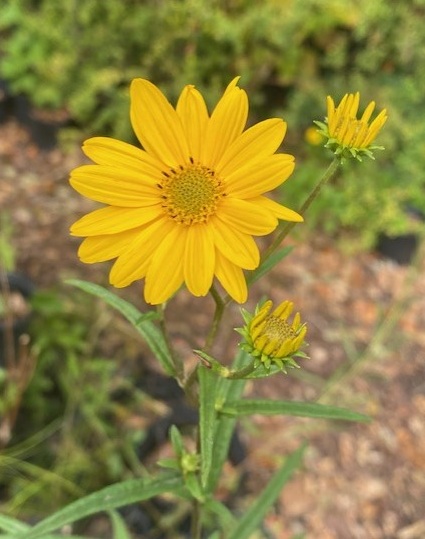
October Daisy (Helianthus angustifolia) is blooming in gardens as well as roadside ditches. Blue mist flowers (Conoclinium coelestinum) and blue curls (Trichostema) contrast beautifully with the yellow glow.
Nature has the capacity to heal, even after devastating hurricanes. Nature grows in layers, each layer adapting to support the whole. This adaptation allows the whole to function, even when damaged. Nature has the capacity to heal. We are also nature. We have the capacity for reciprocity, to adapt, and to heal along side of the nature in our gardens. Keep on planting!



Leave a Reply