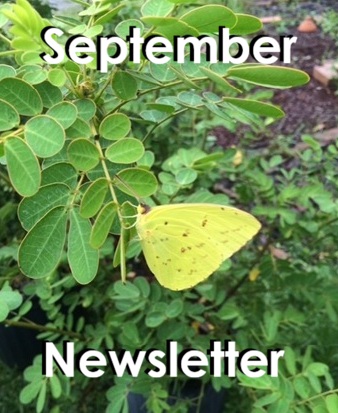
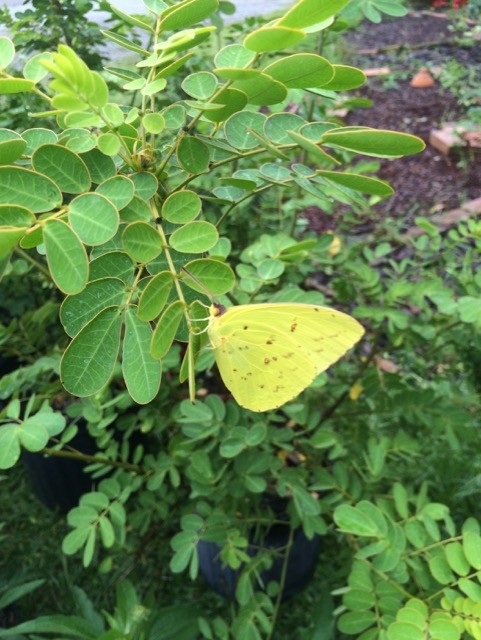
There are lots of butterflies around the garden. Butterflies rarely seen at other times of the year are beginning to show up in greater numbers. Sulpher butterflies are flitting over the garden through the fall — yellow butterflies ranging in size from the large Cloudless Sulpher to the much smaller Sleepy Orange. Sulphers migrate in the fall to warmer areas, just as monarchs do, but range over a larger territory, rather than collect in one spot.
In our area, these beautiful brightly-colored butterflies use plants in the pea family as hosts. One of their southern favorites is commonly called Fall Cassia (Senna bicapsularis). The shrub can grow to heights of 8’ or more, and just as wide. Cassias will bloom profusely in October with bright yellow flowers, that match the color of the butterflies. The female sulpher will lay her white oval eggs at the tip of the newest leaf. These eggs must taste the best of all butterfly eggs to predators. Ants and wasps can be seen crawling over the plants, searching for eggs or small caterpillars. Thankfully, enough of the eggs survive to create a healthy population.
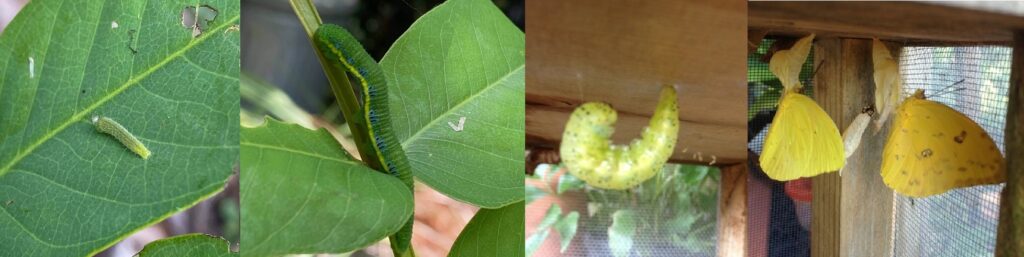
The tiny caterpillars are the same green as the leaf and are extremely hard to find. The last molt reveals a caterpillar that is striped with blue or black, depending on the species. They still blend in, but they are easier to find. The chrysalis looks like a leaf, either peach-colored or green, blending in with the surroundings.
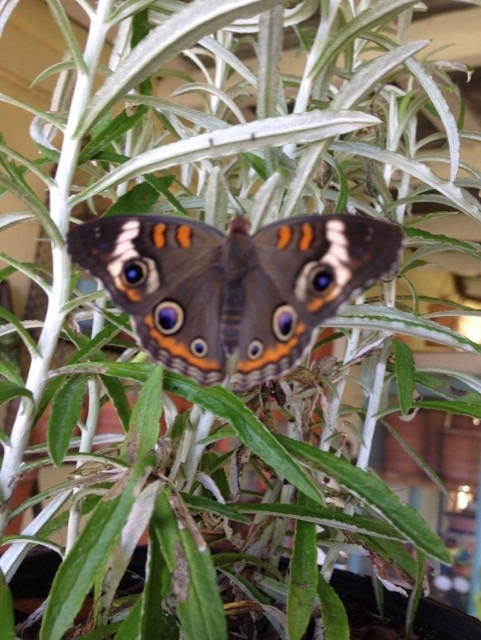
The buckeye butterfly population will also be present in larger numbers through the fall. These beautiful butterflies are named after the “eye spots” that decorate the edge of their wings. Buckeyes are one of the few butterfly species in our area that use a wide variety of plants, both native and non-native, to “host” the caterpillars. Watch for the buckeye caterpillars on frog fruit, twin flower, wild petunia, and firecracker plant.
Other butterflies and insects, birds and other wildlife are taking advantage of the plants for food and habitat. September is a very “berry” time of year. Trees are producing nuts and fruit, and shrubs and vines are producing seeds and berries. All of this is the preparation for the fall “feast” for wildlife before winter slows down the plant’s growing capacity. The wildlife that consumes the berries are invaluable to the plants, by dispersing their seeds.
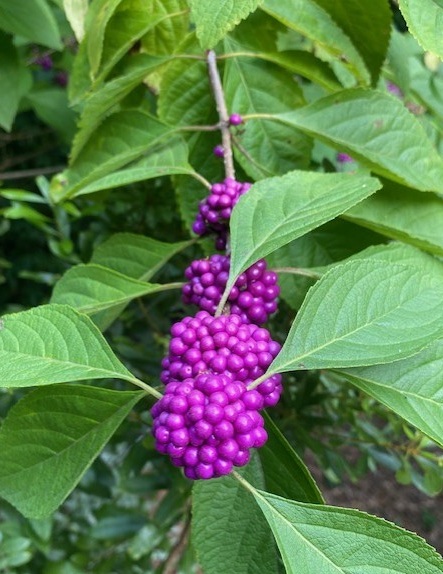
In the garden right now, beauty berries are ripening to a deep purple, cedars are producing their beautiful light blue berries, sparkleberries are beginning to ripen from green to black. Holly trees and shrubs are producing berries that range in color from yellow to red. Vines are also producing berries for birds and other wildlife.
Virginia creeper (Parthenocissus quinquefolia) is an aggressive native vine, climbing and crawling over trees and buildings and anything else it encounters. Its berries start out a beautiful blue color, turning black when ripe. The leaves in the fall turn a brilliant red.
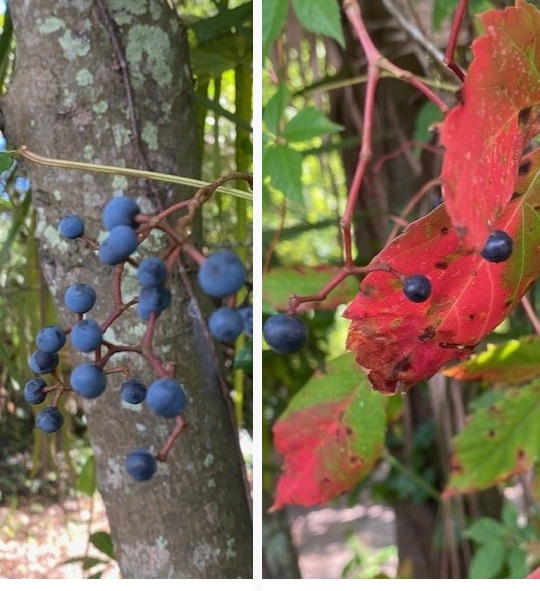
According to a book I have used for many years – “American Wildlife and Plants – A Guide to Wildlife Food Habits” by Alexander C. Martin, Herbert S. Zim, and Arnold L. Nelson — Virginia Creeper is the third most used habitat plant in the United States. (The top two plants are also vines: #1 poison ivy and #2 smilax.) Wherever these vines grow, they provide food and a safe habitat for wildlife. Who would willingly go into poison ivy to hunt a bird? But of course for gardeners, these vines are poisonous, full of stickers, or covering every other plant in the garden!
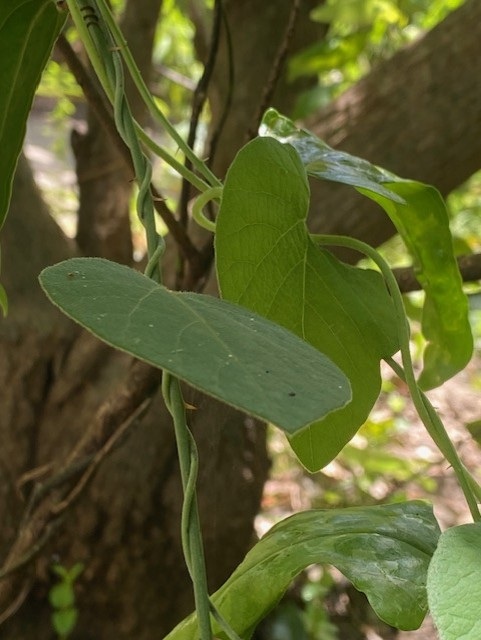
In my garden, our native pipevine (Aristolichia tomentosa) has become as aggressive as Virginia creeper. The heat and the rain have made this vine grow upwards and outwards — far beyond its usually finicky growth habit. The root system is like a slender rope, and very tough.
Pipevine hosts the pipevine swallowtail butterfly — one of my favorites to watch through the life cycle. They are black, with white dots on brilliant blue hind wings. The female selects a vine tendril and lays a cluster of orange eggs on the very tip. The eggs will hatch in about a week, depending on the temperature, and the tiny black and orange caterpillars will emerge. The caterpillars stay in a “herd”, foraging together for about a week, then each goes off separately to feed on the pipevine.
Passion vine, like pipevine, serve as host plants for gulf fritillary butterflies and zebra longwings. Zebra longwings, Florida’s state butterfly, are rare in our area, but seen occasionally. The fritillary caterpillars are orange with black strips and black “spines”. The zebra longwings are white with black “spines”.
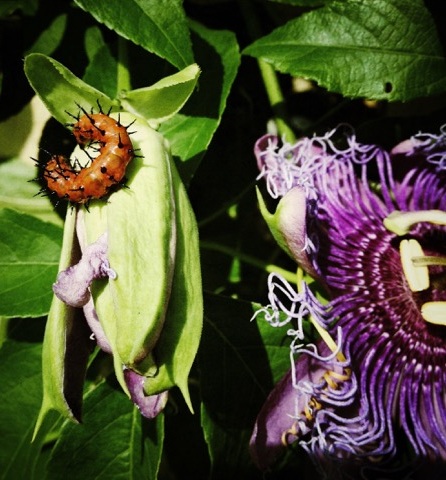
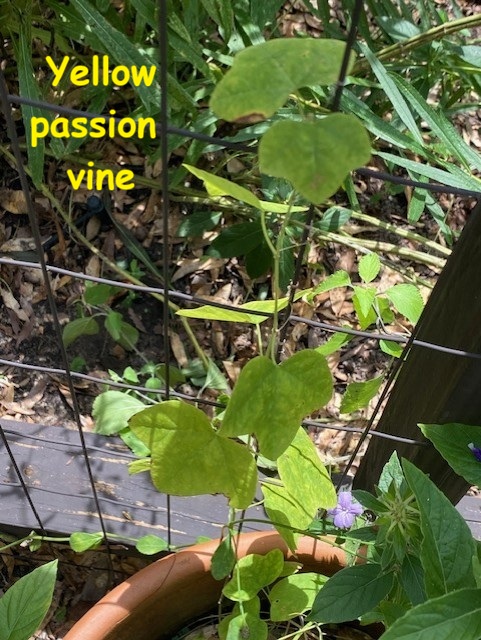
Passion vines that are native to our area include maypop (Passiflora incarnata) with showy lavender flowers, and yellow passion vine (Passiflora lutea) that has a tri-lobed leaf and a small yellow flower. Almost all passion vines have amazing flowers: multi-petaled, with a fringy center and pollen-holding stamens in a four-pronged shape.
The common name “passion vine” has an interesting history. Early Spanish colonists to South America discovered passion vines, and found the flower to be symbolic. The twelve or thirteen petals represented the disciples of Christ, the fringe in the center represented the crown of thorns, and the central stamens represented the cross. So, they named the vine “passion” because it represented the passion of Christ.
Passion vines and their hybrids can cover an amazing amount of territory! The long root system can travel far, popping up new vines along the way. Knowing this fact about passion vines, I planted one in a large pot to keep it contained, but it took very little time for the vine to escape though the drainage hole and make it all the way over to my neighbor’s yard. I planted the yellow passion vine in a pot as well, but I have a stepping stone underneath to keep the vine in check.
Vines do not “read the books” and /or follow instructions, so can cause problems for gardeners. But vines serve a very important function in nature. Vines serve as the wildlife highway between ground and tree canopy, provide stability to the plants that they climb, and provide safe habitat. Vines are also very useful in gardens and landscapes. A vine on a trellis can grow in a small space but give height to soften or cover a wall. For example, if you live in a two-story house on a small lot, a vine can soften the building without blocking access around the side.
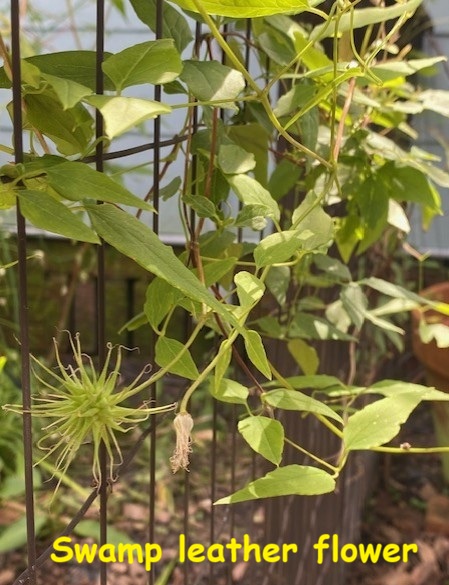
Some vines are more well-behaved than others. Coral honeysuckle is an evergreen, native vine, with red tubular flowers that attract hummingbirds, and bright red berries for birds. Best of all, it is manageable in the garden. Swamp leather flower (Clematis crispa) is another native vine that is well-behaved. This vine is found in moist soils, and grows around 6’ tall. The flowers are cup-shaped, about 2” long, with a lavender tint. They hang like ornaments decorating the vine. This clematis is not as showy as many commercially sold clematis, but beautiful when encountered.
Mexican flame vine (Pseudogynoxys chenopdiodes) has a bright red-orange daisy bloom for hummers and butterflies. If there are zebra longwings in the vicinity, they will be found on the flame vine blooms. This vine dies back or dies in a freeze. More often than not, some of the root near the ground will survive to re-grow in the spring. Mexican flame vine loves heat and comes into its glory this time of year.
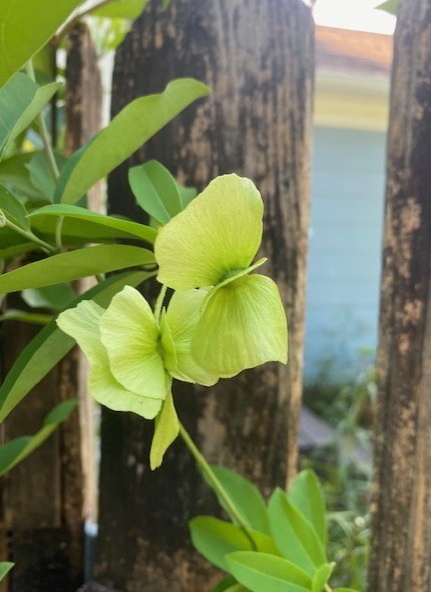
There is another vine with Mexican origins that is beautiful this time of year. The name of this vine is butterfly vine (Mascagnia macoptera), although butterflies don’t seem to be attracted to its yellow flower clusters. But as the flowers die back, the seed pods form in the shape of a dainty butterfly. Butterfly vine is evergreen and (so far) well behaved!
The vegetable garden is full of vines at this time of year, as different species of Cucurbits climb or crawl through the garden. Cucumbers are still winding through the garden. Although they are still blooming, they only seem to be producing a few cucumbers, but I expect a good fall crop.
The Seminole squash is both climbing and crawling — close to 20’ in length. I planted this late but have gotten a fruit. This squash looks like and tastes like a small pumpkin. There are a lot of flowers, so I am expecting a fall crop on these vines as well. Heat seems to be a factor in both of these species. Cucurbits are subject to mildew in hot humid weather. Cooler weather, when the mildew is not as prevalent, seems to bring more fruit from them. When the plant doesn’t use energy to fight off a pest or disease, it has a better chance of reproducing.
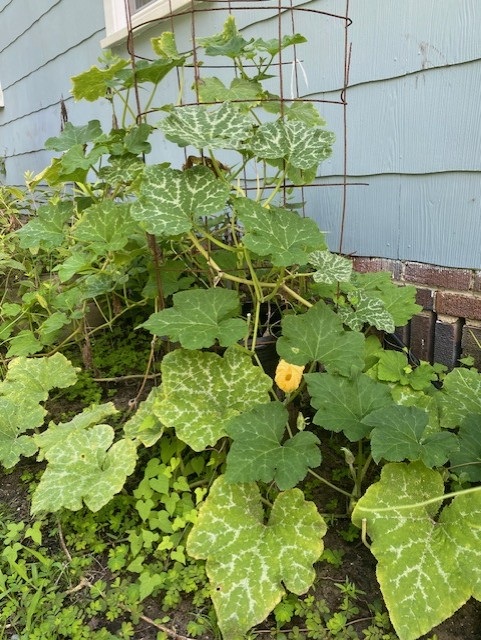
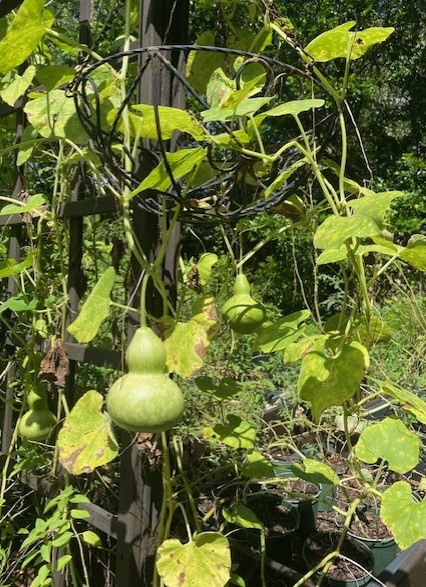
The Cucurbits that climb to amazing heights are gourds. I have had gourd vines reach twenty feet or more up a pine tree. And of course, the prettiest gourds are the highest and hardest to reach. I once grew a crop of “sugar bowl” gourds that escaped up a pine tree. They looked like space ships hovering in the tree! It took an extra-long extension ladder and a crab net duct-taped to a flounder gig to reach them!
Migrating species of birds and insects “fatten up” with this smorgasbord. Hummingbirds are already passing through with many more to come. Adding even just one “habitat “plant to your garden is amazing to watch — the birds and butterflies will arrive very quickly. We planted the first butterfly garden at The Garden Gate on Sept. 1,1997 — and we had monarchs laying eggs within a few hours. Other insects found the garden the first day. Birds came to get the sunflower seeds right off the plants. These days, there is so much more loss of habitat, that planting even one plant can make a difference. It’s really helpful for the wildlife, but we are the ones who win the prize! Watching these animals and plants interact is fascinating. Give yourself a gift and plant a habitat plant.
Some of our native plants that provide colorful flowers and nectar for hummingbirds and other pollinators are now blooming in the wooded front garden: pineland hibiscus (Hibiscus aculeates) is blooming beautifully. The large yellow flowers have a burgundy center. Firebush (Hammelia patens) is a shrub native to Florida that attracts hummingbirds. The clusters of bright red or orange flowers are blooming now. The foliage even has an orange tint to it. Firebush can be grown in sun or shade. It usually dies back in the winter and returns late in the spring. Then it grows fast! Firebush can grow about 6’ wide and high.
Join us on Sept. 23, 2026, 10 AM
Hoe and Hum Garden Club
Gulf Breeze Senior Center
St Francis Episcopal Church, Gulf Breeze
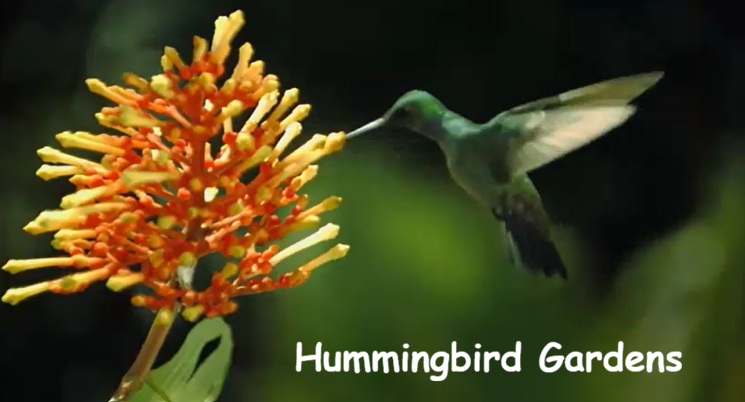
Hummingbird Gardens
Invite Hummingbirds to visit your garden as they migrate through our area this fall. Hummers are not shy — if the plants that attract them are in your garden, these birds will come close for a better view. We will talk about plants that hummers love, and how and where to plant them.
As nature prepares for the next season, gardeners can use this month as a preparation for fall, too. Fall is a good time to survey your garden for any needed changes to make, problems that need attention, or just a general clean-up. As flowers begin to fade on perennials and annuals, dead-heading the old flowers before the seeds drop can save a lot of weeding labor next spring. “One year’s seeds make seven years’ weeds” is the old garden saying.
When the nights cool down, fall vegetable gardens can be planted with greens and root vegetables. Add mushroom compost or cow manure to the soil to give these vegetables a good start. Enjoy the greens and root vegetables (lots of lettuce, spinach, collards, etc. and carrots, turnips, radishes) until the weather warms in the spring. The heat triggers the blooms that attract the pollinators. Seeds mature after pollination, and the plant will then die.
One surprising crop for fall is tomatoes. Most heirloom varieties won’t produce fruit until the nighttime temperature is under seventy degrees. Very early spring and fall are the best times to grow tomatoes here
Herbs generally love the cooler weather. Basil is the exception, but cilantro and dill only grow in cooler weather.
Sow perennial wildflower seeds, particularly the mixed seed packets in the fall. Many seed packets will recommend planting in the spring, but that is information for the central part of the area, usually north of us. Select a site that has more sun than shade, and drains well. Spread a thin layer of compost over the area, and rake or turn the soil. Sprinkle the seeds sparingly over the area, and lightly cover with soil. The seeds only need to be covered to the depth of the seed’s size.
Planting trees and shrubs will have better results in the late fall or winter months, when foliage is dormant. The cooler weather allows the root systems of woody plants (trees and shrubs) time to stabilize the plant before spring temperatures signal the growth of new foliage. Transplanting is also successful in cooler weather, especially with woody plants, and this month is a good time to start that process by root pruning. Several weeks ahead of transplanting, give a tree or shrub the time to grow new feeder roots to take up water and nutrition immediately, instead of waiting for these tiny root hairs to grow after transplanting.
To root prune a tree or shrub: decide the size root ball that you can comfortably transplant. Using a sharp shovel, dig all the way around the plant a spade depth deep. This will cut any lateral roots, but allow them to grow new root tips. Let the plant stay in place for up to a month for new roots to develop, then transplant.
The Navarre Garden Club will be hosting our presentation of “Gardening Where You Live”. The presentation will be held at the Navarre Welcome Center on Sept. 14th, from 10am -11:30. The discussion will include a wide range of gardening information specific to our area: soil and soil amendments, watering and drainage issues, seasonal plant selection and when and how to plant, starting seeds and propagation, fertilizing and pruning. Bring your questions!


Leave a Reply