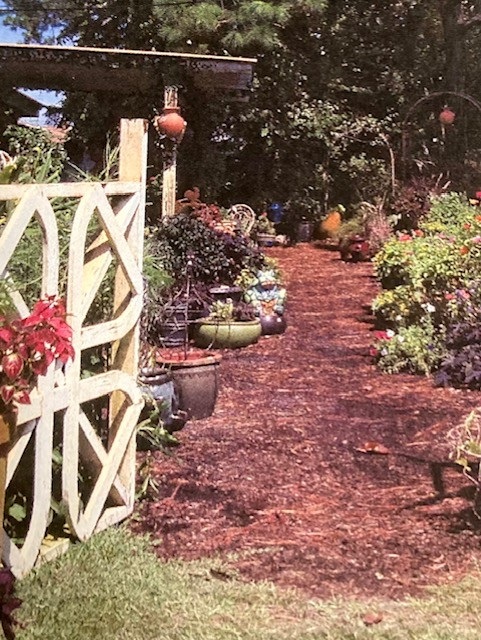
My tiny screened porch is my best “inside-out” spot. The over-planted front yard comes close to the screen. My “trifecta” of habitat trees fills the right half of the view: a pagoda dogwood, still in berry; a wax myrtle and a red cedar. Birds are always in these trees for food and shelter. The left side has lower vegetation so there is a clear view of the sky. I can watch the high-flyers, like hawks and Mississippi kites, plus dragonflies and then bats in the evening. Butterflies are flying and floating by right now — this is prime time for butterflies.
Last week, a large hawk visited the neighborhood at dusk several nights in a row. The “home birds” (non-migrators) raised a ruckus and the hawk loudly complained as the birds dive-bombed him. Several days ago, while I was on the porch, I heard the hawk in a neighbor’s yard, then suddenly he flew into the “trifecta” — first the dogwood, then the cedar. Birds in the vicinity flew up and out. I don’t think the hawk got any prey, but it was amazing to see.
Sitting on my porch, a fan makes it bearable this time of year. We are in the season of heat. From now until the middle of September, when the nights begin to cool down, our gardens are “stockpiling” energy from this season — light and heat provide the power for plants, insects, birds, and other wildlife to “fatten up” for long migrations, for long periods of dormancy, and for reproduction. The ground will hold a tremendous amount of heat, keeping soil organisms alive and busy breaking down organic matter that ultimately feeds us all.
Sometimes there is too much of a good thing. Heated air can harm foliage of plants that don’t have sufficient water, and heated soil can become fallow if there are no layers of shade, vegetation, or mulch to balance the heat. Often leaves will “droop” in the mid-afternoon heat, so that less sun is directly on the surface. This is an immune system response. Plants have immune systems, just as people do. When plant immune systems are stressed from heat or other causes, plants are much more subject to pest insects and diseases. Drooping or discolored leaves, or die back are signals to insects that this plant is ailing. I’m seeing mealy bugs and white flies in my garden on plants that aren’t watered frequently, and mildew on some fuzzy leaf plants.
The predator insects move in to eat the pest insects. Then the “home birds” eat the predator insects. There are ways that gardeners can help the plants stay healthy, and less attractive to pests. Watering evenly at the root zone, early in the day or just before dawn, is the primary way to keep plants healthy. Mulches will help keep the soil at an even temperature. This is NOT a good time to cut back or fertilize plants. Cutting back requires plants to exert extra energy to overcome the “wound”. Over-fertilizing forces the plant into new growth instead of using its energy to meet the heat.
As for the pest insects: a spray of barely soapy water (no “de-greaser” detergents — better to use Joy or Ivory) mixed with a little vegetable oil, sprayed on both sides of the leaves will desiccate soft-bodied insects. The adults might fly away before coming into contact with the spray, but it will kill the new generation. A repeat spray might be needed in about ten days. The idea is to restore the balance of pest and predator.
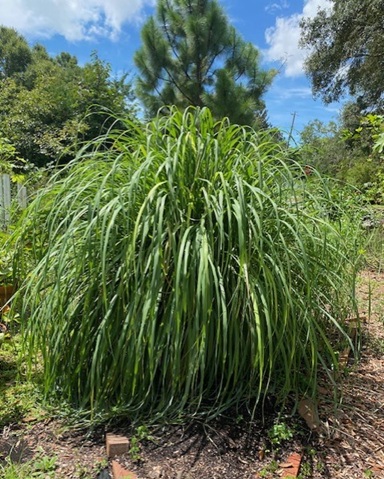
Some plants are thriving in the heat. Okra is producing lots of pods, basil is loving the heat, the lemon grass is an astounding 6’ tall and wide. Other grasses thrive this time of year, especially some of our native grasses.
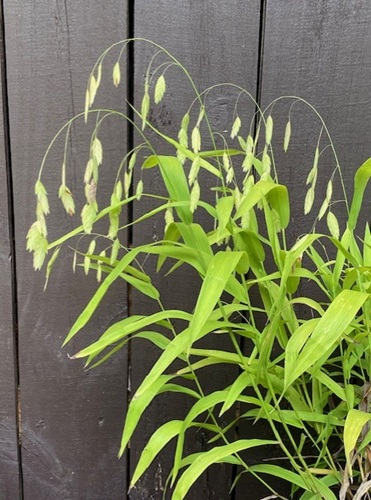
Inland sea oats (Chasmantheum latifolia) are blooming. The common name for this grass comes from their seeds, that resemble the sea oats on the beach. Another common name for this grass is river oats, because they are usually found in inland areas, often along river banks. Inland sea oats grow well in more shady sites than most grasses. They die back after frost but return in the spring. The seeds are widely used by birds and other wildlife.
Most of our other native grasses will bloom later in the fall when many wildlife species will be migrating. Muhley grass (Muhlenbergia capillaris) has become a very popular landscape plant with its gorgeous pink plumes in the fall. There is a white species of Muhley grass that is also very showy. One thing to note about the pink Muhley grass: plant this in groups where they will be backlit by the rising or the setting sun to get full effect. The light behind the grass will make the bloom actually “glow”.
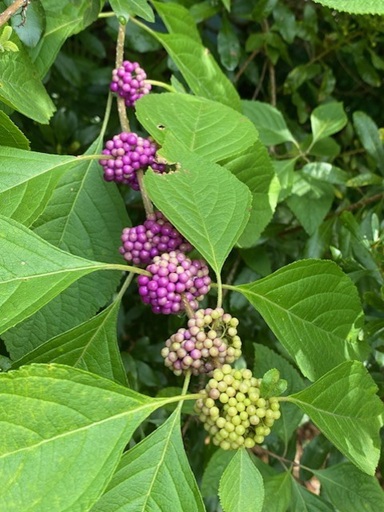
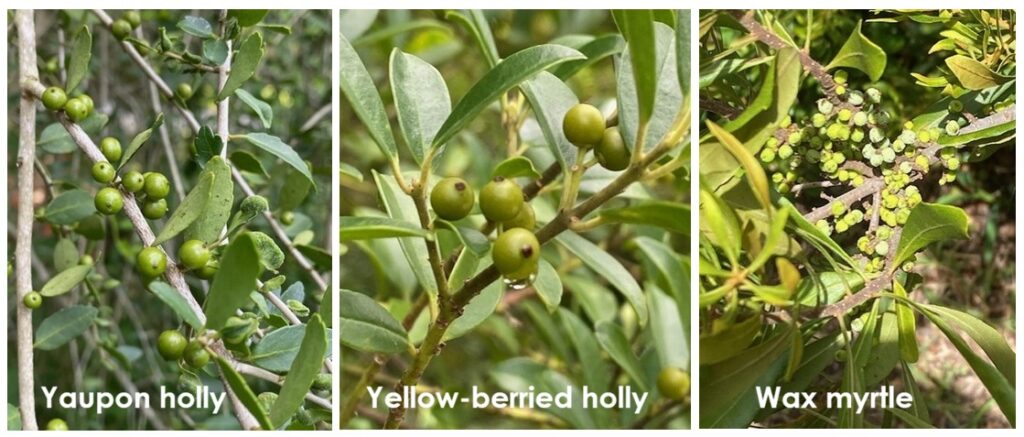
Seeds of the beauty berry are becoming tinged with purple; sparkleberries are full of berries hanging low; the hollies —both yaupon and yellow berried — are producing; wax myrtles are full of berries. The grass seeds, the ripening berries, the acorns and other nuts are invaluable for migrating birds.
This summer, the berry-producing plants are working over-time. This is also an immune response. Plants that are stressed by weather, or any outside event, respond by putting extra energy into reproduction.
Many of you remember Hurricane Ivan in 2004. The wind was so strong that acorns were blown off the oak trees before ripening. Acorns are the primary winter food source for blue jays and other local birds that ordinarily don’t migrate. That year, the blue jays actually migrated north in the winter to find their food source. Last spring we had a record number of acorns in response to the winter freezes.
The hummingbirds are often the first migrating birds that we see. They will begin their trek to South America soon, also following their food sources. Get you feeders ready!
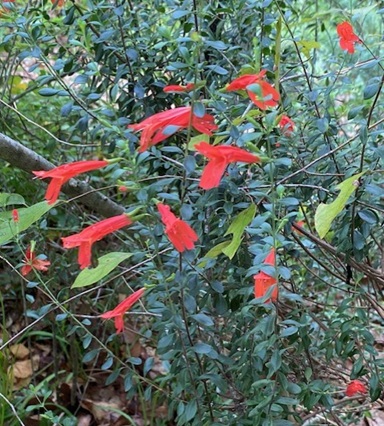
There are late summer and fall blooming plants that hummers love, to grow in your garden. Many have red blooms (there is a reason most hummingbird feeders are red!). Fire spike (Odonotonema cuspidatum) and red salvia (Salvia coccinea) are favorites. Two other native plants are already blooming in my yard: red calamint (Calamentha coccinea) and wax mallow (Malvaviscuous drummondii). Both of these shrubby plants tolerate dry soils (even the beach), and sun to part shade.
Insects love the heat. There are a lot of butterfly species active in the garden right now. Monarchs, fritillaries, several species of swallowtails, plus bright yellow sulfers are back on the scene, and I saw a painted lady for the first time since spring. The smaller butterflies are now very active — there are lots of dusky wings on the frog fruit to lay eggs, as well as the iron weed and other blooming plants.
Other native plants attractive to pollinators are blooming this month, including starry rosin weed (Silphium integrefolium), horsemint (Monarda punctata), and St. Andrew’s cross (Hypericum hypercoides).
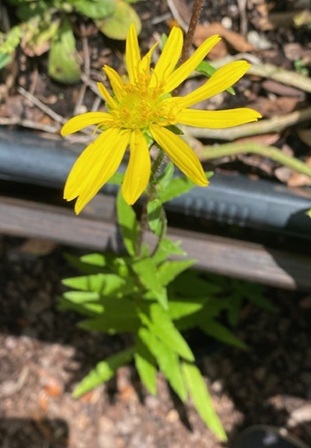
The yellow daisy-shaped blooms of rosin weed “reach for the stars” with stems growing up to 5’ high. Rosin weed gets its name from a gooey substance in its stems that has traditionally been used for chewing gum, as well as medicinally.
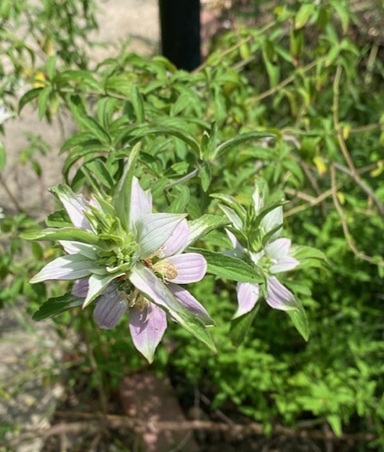
Horsemint is a bee balm that is native here. Horsemint can get up to 3’ tall, and since it reseeds freely, it is all over my yard. By next week, the many plants will show off their tiny flowers with a “collar” of bracts, rather than petals. The pink to lavender bracts are showy and the tiny flowers are very attractive to pollinators. Like most plants in the mint family, horsemint has scented leaves.
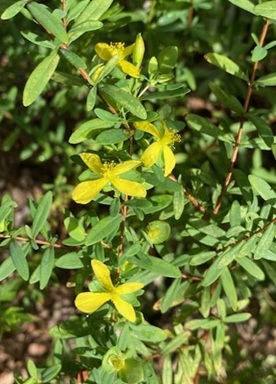
St. Andrew’s cross is a small evergreen shrub in the St. John’s wort family. It grows to about 2’ in height and slightly smaller in width. The bright yellow flowers are used by bees and other pollinators. Bees especially use this plant. St. Andrews’s cross readily reseeds in dry areas.
I’ve been thinking of “porch plants” lately. Even though I am surrounded by plants just outside the screen, plants in containers would bring more of the “outside in”. But…. aside from the small space, and a curious cat, I would have to be the one who waters the “porch plants”. Succulents fit the bill.
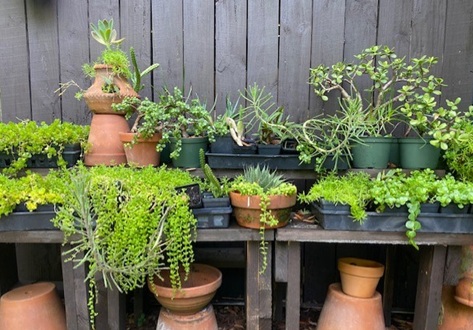
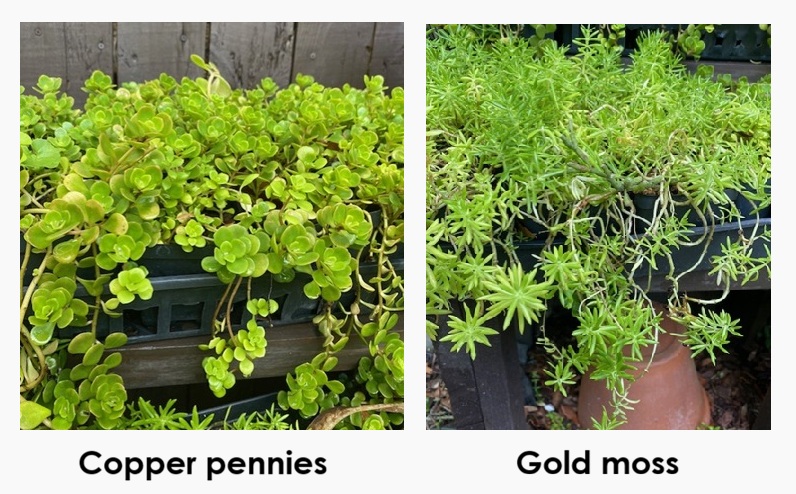
Some succulents grow upright: many cacti, jade plants, and sedums are examples. Many are also ground-covers or trailing plants. Mixing succulents is very eye-catching in a container, with different heights, textures, and foliage colors. Some of my favorites are trailing sedums. “Gold moss” (Sedum linare) is so named because the bloom is bright yellow in the spring. But gold moss is an eye-catching light green that trails all year. Another beautiful trailing sedum is copper pennies (Sedum nusbaumerianum). Copper pennies have flat leaves slightly smaller than a real penny, but they turn a reddish coppery color in cool weather. We mostly used succulents for our “Fairy Gardens” class at The Garden Gate.
“Fairy Gardens” was always a popular summer class. Parents and kids could make a fairy-sized garden in a saucer with an added drainage hole. We started with “fairy-sized” structures, then added succulents or other small plants. This is a great hands-on gardening activity. Succulents can be used to make living wreaths or kissing balls, among other creative uses!
Succulents generally do well in our area, in pots or in the ground. Some succulents cannot tolerate our humidity, however. Some are not hardy and will die in a freeze. Succulents like heat.
Some succulents will take over your garden. “Mother of all Plants”, “Mother of Millions” and “Mother of Thousands” are common names for several species of Kalanchoe, that produce many tiny plants at the tips of their leaves. These fall to the ground where the quickly mature. Very soon, you will have “thousands” of plants! Succulents are great “pass-along” plants, because they multiply quickly with no effort or care. Just throw a sprig on the ground and walk away! Over-watering is just about the only thing that harms the hardy ones.
Growing succulents in containers is also easy — with only a few important considerations. The soil must be well-drained. If you are buying a commercial mix, adding perlite or fine pine bark will help the drainage. The size of the pot can affect the health of succulents if it is too large. Succulents’ root systems are usually very shallow, and a pot too deep will hold enough moisture to rot the roots. You can still use a larger pot if you “cheat” by supporting a smaller pot inside. We use upside-down plastic pots to fill the space, then set the pot holding the plant on top. Or the large pot can also be filled with other substances such as pebbles, or even styrofoam peanuts, but weed barrier must be used to hold the soil. Otherwise, the soil will drift down through the filler.
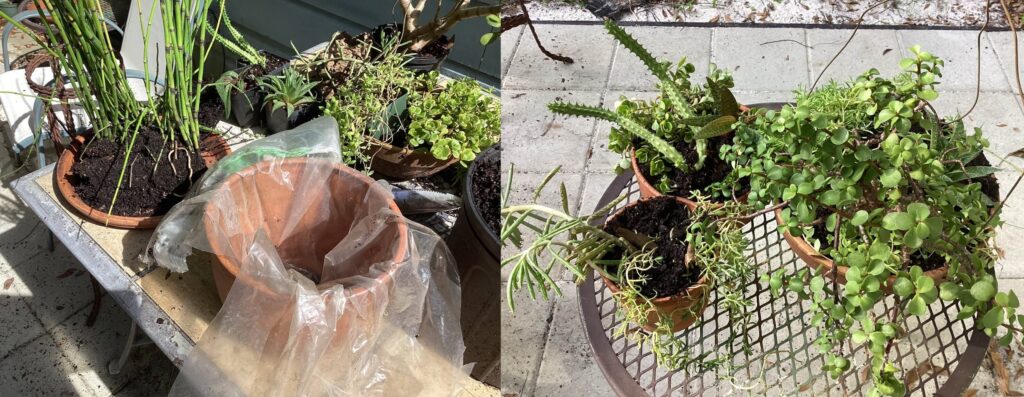
If you use a saucer under the pot of succulents, raising the pot slightly above the saucer can allow the plant to drain without the water escaping the saucer. Three or four small ceramic tiles, about 1” sq., will lift the pot to a good level.
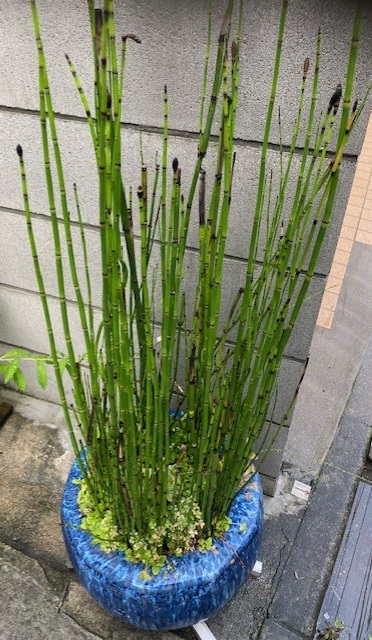
I think several mixed containers of succulents would be great for my porch, but there is one small space where a taller plant would work. My choice is the opposite of a dry-loving succulent. Horsetails are a wetland or aquatic plant, but are also easy to grow in containers. Lining a pot with plastic prevents water from draining, so the horsetail remains moist for longer periods. Less watering for the gardener!
This season of heat is also a time of watching the garden rather than working in it. I hope you have a porch with a rocking chair to look out over your garden!



Leave a Reply