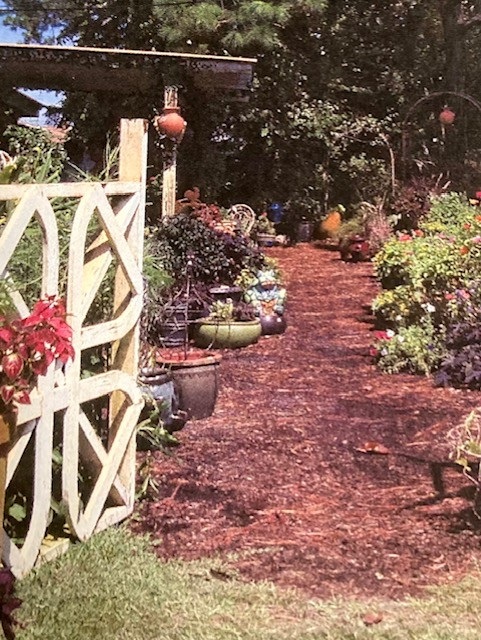

For a while towards the end of May, it seemed like summer might gradually move in. But June 1st brought a temperature in the high eighties, and high humidity. Then a day later, we had cooler, drier conditions. Summer may be playing hide-n-seek, but it will definitely arrive!
Our heat comes from our proximity to the equator, but our humidity is mostly a result of our topography. Humidity comes from water heated to the evaporation point. This heated water lingers in the air until it reaches the saturation point, and rains back down. And we have a lot of water!
Our “area” — which I define as the four western-most counties in Florida, have unique growing conditions. Our rainfall ranges from drought to flood, our soils range from sandy to heavy clay, our temperature from ninety degrees or above to well below freezing. Due to our proximity to the Gulf, our growing conditions can include very high winds, and sometimes, salt in the air from tropical systems. But humidity is one of the defining growing conditions for us. It often determines which plants thrive here.
Our bay systems play a large role in the humidity. Northwest Florida is the basin for much of the water coming off the western Appalachian Mountains. This water from the mountains flows down the rivers to empty into our bay system. This sets up a water to air to water relationship, especially in hot weather. Water from the bays evaporates into the air until it saturates the air, then rains back down. It is beautiful to watch the summer thunderstorms form around the bay, move along the shore or slightly out over the water as the rain falls back to earth. The temperature of the water in the bays plays a role in how the storms move.
Humidity affects plants in several ways. The water in the air can keep the foliage damp, making an ideal environment for fungus disease. Mildews are common problems in the hot weather, particularly on plants with fuzzy leaves. The fuzz actually holds more water on the leaf. Fungus diseases are some of the hardest for gardeners to prevent. The easiest measure is to make sure plants prone to fungus have good air circulation, so that the leaves have a better chance to dry. Another preventive practice is to water only the root system instead of watering the foliage, and to water early in the day (just before dawn, if possible). This allows water to be absorbed by the roots, but allows any excess to dry more quickly from the foliage. The good news is that in the areas that have the most humidity, the soil (also carried down from the Appalachian Mountains) is very sandy and well-drained. That’s perfect for a humid area!
Summer brings other changes to the garden. The baby birds that hatched in spring have fledged, so there are no longer chicks to “cheep” for food and attention. The adult birds aren’t loudly giving out loud warnings to the chicks. There is far less activity and commotion. The birds are still noisy in the early mornings and evenings, but mostly quiet in the midday heat. Even the squirrels are laying low in midday. Turtles are on the move, looking for mates. Lizards are everywhere, taking care of pest insects. Frogs are still singing at night and in the rain.
Butterflies are visiting more frequently. The hotter the weather, the more insects we will see — the pollinators, pests, and the predators. I had three eastern black swallowtails hatch in my butterfly box last week. Two survived and flew away, but the third was tightly wound up with the web of a spider. I’m not sure how the spider got in the box, but the newly hatched butterfly was covered with the web. I removed the webbing but I was too late to save the butterfly.
Part of the cycle and circle of life in the garden is this balance between predators and prey. Nature can certainly be deadly and destructive. But nature is never malicious. In the summer garden, there are examples galore. If spring is the season of birth, then summer is the season of feasting and feeding. Almost all species (both plants and animals) are feeding heavily, gaining energy, and reproducing. This stored energy will carry many species through long fall migrations, or through periods of dormancy in the fall and winter.
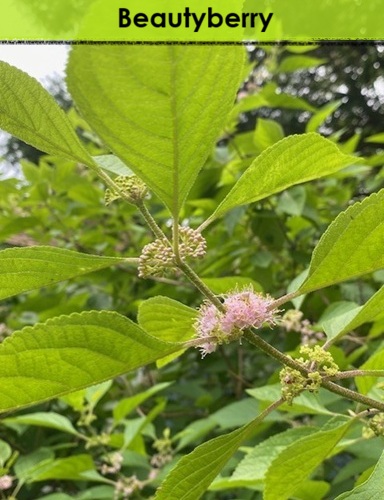
And their food sources are appearing. Flowers for pollinators are beginning to bloom. Trees and shrubs are beginning to produce berries. The wax myrtle, the yaupon and the yellow berry holly, the pagoda dogwood, and the beautyberry are all blooming or have new berries beginning to grow. These berries, plus the nuts produced by oaks, hickories, and the seeds from pine cones, will be the staple diet for many of the local birds and other wildlife, and feed the migrating birds coming through in the fall.
The blackberries are slowing down their production, at least for a while, much to the disappointment of my “berry bandits” — the squirrels and birds that visit the plants every day. Blackberries will be using their energy to send up new plants from the roots. These “suckers” are free plants to transplant.
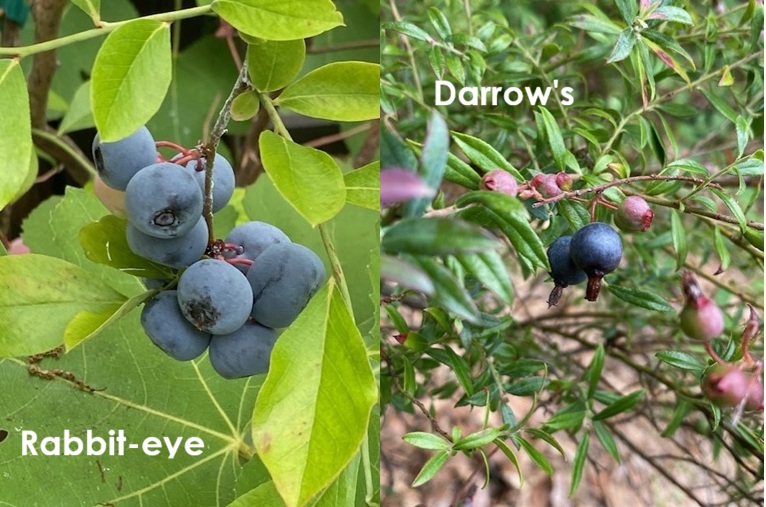
The blueberries, however, are in full production – both the rabbit-eye and the smaller Darrow’s blueberries. I am having a hard time keeping up with picking them, which works out great for the birds!
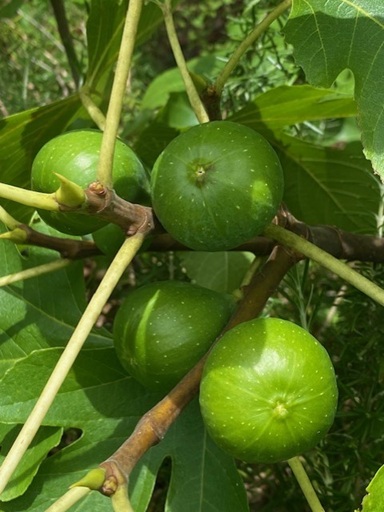
The figs are getting huge, but they are about a month from ripening. The huge green fig tree lost all the early figs in that last cold snap, but it has put out a second crop. Interestingly, it only has figs on one side of the tree. This fig tree is about 15’ wide and 9’ high. This tree grows close to the road, and the sweet fruits are popular with birds, squirrels, and neighbors.
The herb garden is also “shifting” in the warmer weather. All the thymes begin to suffer in the heat and humidity. Many may die. English thyme and lemon thyme usually tolerate the humidity, but do not thrive. Dill and cilantro are beginning to bloom and will soon die after being pollinated and setting seed.
On the other hand, basil is just getting started. And there are so many kinds of basil! Most basil is easy to start from seed. It is important to remember to remove the basil flowers as they begin to bloom. If the flowers are pollinated and produce seed, the plant will die shortly after.
Some of the basil that are easy to start by seed are sweet basil, Thai basil, purple basil, Genovese basil, holy basil, — the list goes on. One of my favorite basils is African blue basil, because is one of the best pollinator plants around, and this basil must be started from cuttings. It does not produce viable seeds. So African basil can bloom all it wants to, and it does! This basil will to continue to bloom all summer until frost. These blooms are so popular with bees and other pollinators, that it is a wonderful addition to a vegetable or pollinator garden.
This time of year, both the herb garden and vegetable garden are growing and productive. The onion chives are blooming with pink powder puff flowers. The garlic chives are full (they will bloom later in the fall). I’m getting a lot of cucumbers in the garden, and the tomatoes are ripening. My sweet banana peppers are producing like crazy! I’ve been experimenting with both garlic chives and onion chives, adding them to my salad recipes in place of chopped onions.
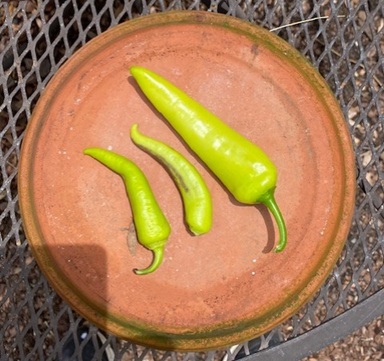
Chopping these veggies and adding chives or green onion stalks makes a wonderful warm-weather salad. Top with olive oil and white wine vinegar and sprinkle parsley, basil, and oregano. Add salt, pepper, and a little garlic to make the perfect dressing. Occasionally, I add just a little fine-chopped cheddar cheese and cream cheese. It is delicious!
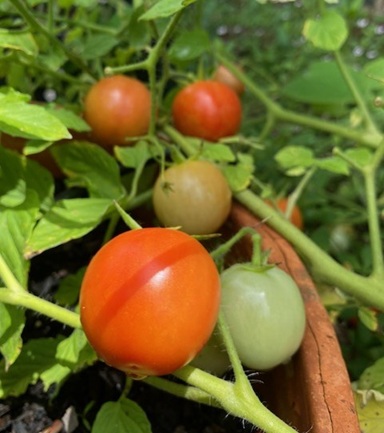
I have a lot of tomato plants this year — tons of tomato seeds in my compost germinated in every bed where compost was added. Almost all of the plants have produced tomatoes and they are all ripening at once! But thanks to summer, for most of the tomato varieties, no more fruit will be produced until fall. Most heirloom varieties of the larger tomatoes will produce fruit only when the nighttime temperatures are below 70 degrees. For people who have moved from places north of here, this seems incredible! Do not despair!
The temperature requirements of plants are built-in genetically. Luckily, we usually have a long fall and mild winters, when the tomato plants can bloom and set fruit. If you are growing tomatoes that have stopped producing, those plants will begin to produce fruit again in the fall, assuming that the plants survive the summer. Tomato plants are subject to fungus diseases (from the humidity!) in hot weather. Good air circulation will help, as well as watering the roots instead of the foliage.
Winter-grown tomatoes will have to be covered if a freeze hits the area, but you will get lots of tomatoes! Fall tomatoes can come from existing plants, from cuttings, or seed. Cutting should be taken in late August or early September.
Late last month, I planted my okra seeds in the garden, after soaking them overnight. This softens the seed coat and speeds germination. Now that the okra has germinated, I will plant black-eyed pea among the okra plants. I did this last year and had great results — the peas climbed the okra stalks, so I got two crops in one garden bed. I might even try growing sweet potatoes under okra this year, too.
Okra is a member of the mallow family, and is related to hibiscus. The bright yellow flower is a giveaway — it looks exactly like a big hibiscus flower. Even if you don’t eat okra, this flower can decorate your garden. Hibiscus loves heat! And like other members of this family, it blooms throughout the hot weather.
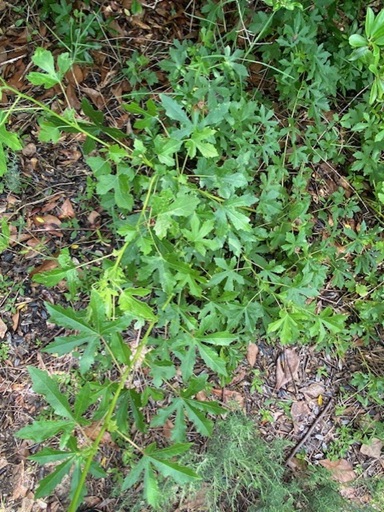
Another native hibiscus that has a yellow bloom is pineland hibiscus (Hibiscus aculeates). Pineland hibiscus also has the common name of comfort root, and it does have a tuberous root. It has been used medicinally for many centuries as an anti-inflammatory and for its throat-soothing capacity. Pineland hibiscus can tolerate dry soils, some shade, and has a sprawling habit rather than growing upright. It’s a great addition to a woods edge or native plant garden.
Summer is the season of “yellow”! Pollinators are strongly attracted to yellow flowers, so we will see lots of yellow flowers through the rest of the year. In fact, our fall color is predominately yellow wildflowers. We often think of sunflowers when we think of yellow flowers. I have two native species in my garden. The dune sunflower (Helianthus debilis) is just beginning to bloom.
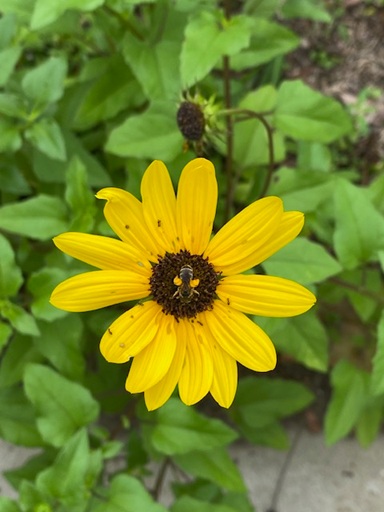
My dune sunflowers died back in the freezes of last winter, but this native plant is a good self-seeder. Every year they come back from seed with more and more plants. That suits me fine! As its name implies, dune sunflower grows on the beach as well as inland. Dune sunflower is low growing, but very wide — sometimes as wide as 8 feet across. The yellow daisy-shaped petals have a dark center as most sunflowers do.
Another native sunflower—commonly called October daisy, (Helianthus angustifolius) begins to bloom in the fall, lighting up the ditches and wetlands in our area. October daisy can reach a height of 6 feet and spreads from the root to take over an ever-expanding space. It is easy to control, however. Its roots are not deep. It can be pulled up and transplanted. Sometimes October Daisy gets too leggy for a flower bed. If it is, cut it back to about 12” in June, then by October when it blooms, it will be a manageable 3’-4’ high. Nothing matches their fall color!
Most of us are familiar with the Black-eyed Susans — members of the Rudbeckia family. This group of annuals and perennials produces long-blooming yellow flowers. The tall coneflowers are just starting to bloom in my garden. They are spectacular with a tall cone about 2” high and large drooping yellow petals.
Another favorite perennial for pollinators is also blooming bright yellow right now. This is patrina (Patrina scabiofolia). The beautiful lacy blooms are always covered with pollinators. Patrina looks like a completely different plant in the winter — as the foliage changes shape.
The other “species” that has a lot of energy in the summer is children! Since school is out for summer, there is a great opportunity to garden with our children and grandchildren. It is always amazing how much can be learned from gardening with children — they see much more than adults. Exploring the garden with a child opens the door to a life-long curiosity about nature. Experiencing a garden with a child (or with anyone) can make a lasting memory, if not a lasting bond. There are a million ways to garden with kids, but remember — school is out! Gardening with children is about sharing a “hands-on” experience. If you don’t have children to garden with, garden with some friends! Just have fun!



Leave a Reply