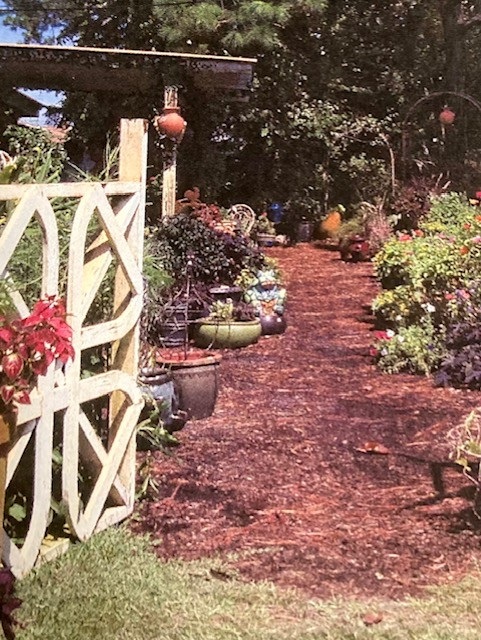
October always brings back memories for me! After a summer of hard work, my two daughters, Elanor and Liz, and I opened The Garden Gate for the first time on October 1st, 1997. At the front of the building was planted a bed of native perennials. At the entrance to the shop, our scarecrow, “Pat” greeted visitors. Inside the gate, there was a pond and bog garden, a butterfly garden, an herb garden, and a children’s garden.

Over the years, we offered classes and seminars to our customers, and added landscape design and installation. Our space expanded and contracted, but one thing remained constant— the best gift of The Garden Gate was sharing experiences with customers. I learned so much more about gardening than I knew coming in. Experience is the best teacher, and I thank you all for sharing your gardening experiences. Sharing with other gardeners was always insightful.
When I am writing the newsletter, I often wander out in the garden for a while, for fresh inspiration from what I encounter. The first few days of early October brought pleasant temperatures, a lovely breeze, sunny skies with a few wispy clouds. While leaning on a post in the veggie garden, I have a view of the squirrels playing chase in the huge live oak across the street, up and down, back and forth, round and round (just like all the rest of life!). The mockingbirds are talking; a woodpecker declaring his territory; the sparrows are in the cedar nearby, completely hidden from view, but letting themselves be known with a continuous chirping. The huge green fig tree and the blueberry bushes are also visible from this spot.
Butterflies are everywhere this time of year! Skippers are doing a mating flight, with their host plants (beans and field peas) close by. Fritillaries are gathering nectar from everything that’s blooming, it seems. Two different species of sulphers are passing by. Bees and other pollinators are massed on the horsemint and the African basil. And then there is “Bev” — my beautiful 20’ long leaf pine — with her pom poms of needles swaying like the famous hula dancer she is named for. All of this is happening at the same time as I stand in the same spot. I get to watch and enjoy it all! One of the best gifts of gardening is to stand back and appreciate the garden.
I think that October is our most colorful month! Along the roadways and in gardens, wildflowers are putting on displays of color to attract pollinators before the cold weather arrives. Blooming native shrubs add even more color.
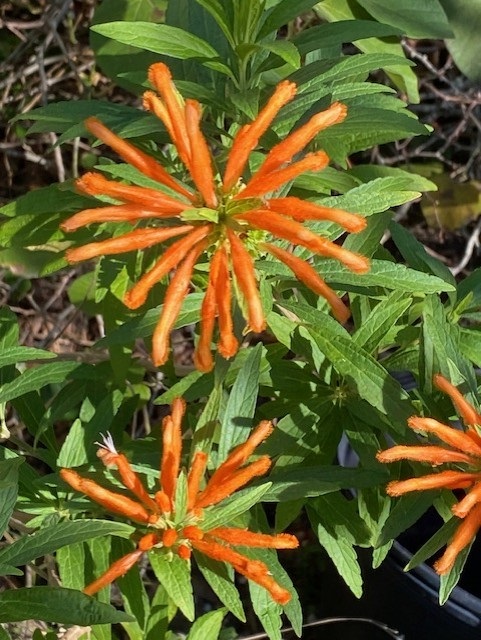
Red and orange blooms are glowing in the garden and attracting the hummers that use them. Blanket flowers (Gaillardia ssp.) have been in continuous bloom since spring. Fire spike, fire bush and red calamint are in full flower this month. My Lion’s Ear (Leonotis leonurus) just has two blooms so far and two hummingbirds are battling over which one will get the nectar. Lion’s ear can get up to 6’ tall and will be covered in orange stacked blooms by next week. Perfect orange flowers for a Halloween arrangement!
Yellow seems to be the most prevalent color in October. There are many species of goldenrod (genus Solidago) and many of them are native to our area. These bright yellow blooms grow from wood’s edge to the beach. Goldenrod gets a bad rap — many people blame this gorgeous plant for fall allergies. Actually, the culprit is usually ragweed, as goldenrod pollen is too large to be inhaled.
Three of our native sunflowers are strutting their stuff. The dune sunflower (Helianthus debilis) has been blooming since late spring, and it will continue until cold weather. That’s about eight months of continuous bloom. This low growing sunflower gets about 1’ high but spreads out in every direction, up to 8’. That’s a lot of plant! They love the sun, and as the name implies, grow well even on the beach. But they also grow well pretty far inland. The dune sunflower is a re-seeding annual, so it will die in cold winters but pop up in great numbers in the spring.

The narrow leaf sunflower (Helianthus angustifolia) is also commonly known as October daisy. This sunflower is a very hardy perennial that spreads from the root. It loves to grow in sunny ditches or moist areas but will tolerate drier sites. It normally reaches a height of 4’-6’ when it is blooming. The flowers are a bright yellow (think school bus!) daisy shape with a dark center that cover the plant when in full bloom.
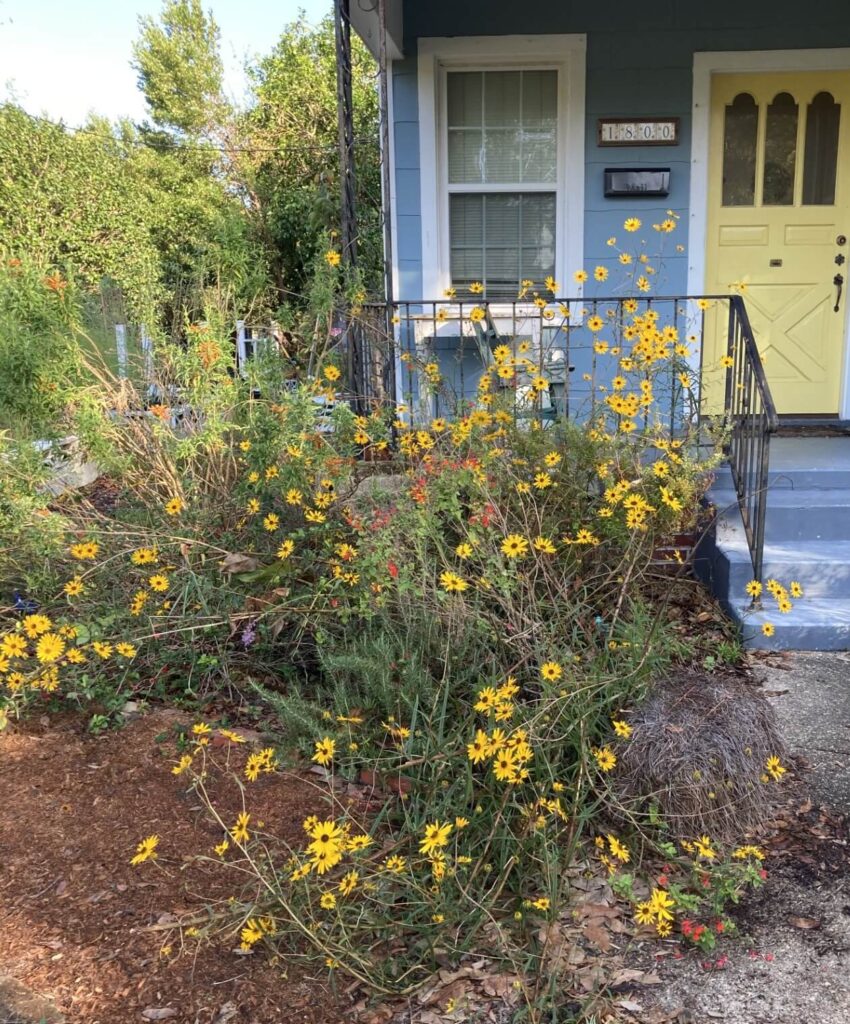
With their size and spread, October daisies can sometimes cause space problems in flower beds. They are easy to pull out if they take over too much territory. If fact, most of us get October daisies from other gardeners who have a few (hundred) too many. They are truly a pass-along plant. As for the height, if the plant is cut back in June to about 1’, they will top out in October at about 3’ instead of 6’.
We have another sunflower blooming now that is a favorite of mine: the rayless sunflower (Helianthus radula). This sunflower has no petals! We often think of the petals of a flower as the “flower” but actually the center of the bloom is the flower. The petals are there to attract the attention of pollinators, but the nectar and pollen are found in the center. The rayless sunflowers also grow in moist meadows, sometimes in great masses. They have a basal rosette of fuzzy leaves and a straight stem that seems almost woody. Rayless sunflowers aren’t always easy to grow in a garden setting. I have my best luck with them in a moist container.
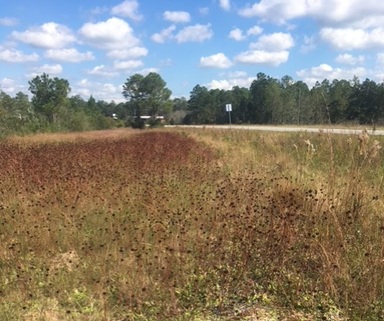
In case you are wondering why I like a black flower so much — Years ago, I started crafting with dried flowers and other natural materials, and for many years had a business making and selling these crafts. At The Garden Gate, we made and sold these “creations”, and taught how-to classes for those who wanted to learn to collect, prepare, and use natural materials to create. I still love to use natural materials to craft, but I am a lot more conscious of collecting “habitat”. As our natural areas shrink, our butterflies, birds, and other wildlife need all that remains. Planting a garden that includes native plants as well as other plants useful to wildlife as well as people is satisfying on many levels, but watching all the life that enjoys the garden is the best.
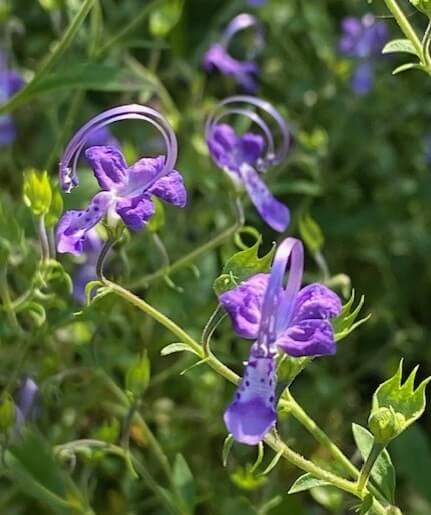
There are blue flowers blooming, to compliment the yellow blooms. Blue mist flower (Conoclinium coelestinum) is often found blooming in the ditches alongside the October daisy. It does well in gardens too. Blue curls (Trichostema dichotomunm) are common woods-edge plants in our area. Usually an annual, they are very good re-seeders. The flowers are small, almost orchid-shaped, but the entire plant is covered with them. Blue curls re-seed in my yard so that I have masses of them blooming in October. They like a dry soil and are adaptable to varying light conditions.

We are also getting color from some of our native shrubs. Woody goldenrod (Chrysoma paucifufolia) is not a true goldenrod, but is a native small evergreen shrub. It blooms in the fall with a bright yellow bloom, like true goldenrods, and flowers at the same time. Woody goldenrod grows on the beach and in sandy soils along the Gulf Coast. This plant also grows great in my dry Pensacola yard.
Pink and purple flowers also bloom this time of year. Bush clover (Lespedeza thunbergii) is blooming now and what a gorgeous display! Sprays of pink flowers on gracefully arching stems (up to 8’) grow from the center. My bush clover grows in a large container. This plant grows ever larger from the base, and can be hard to keep in bounds when planted in the ground. Native to the Eastern U.S., bush clover goes dormant in the winter, but it is fully hardy in our area.
Some of our pink and purple natives also bloom in October. Blazing star (Liatris ssp) is lovely in a flowerbed and long-lasting in flower arrangements. Obedient plant (Physostegia virginiana) grows in moist soil. In my opinion it is not at all obedient! It was given that name because it is easy to bend into place in a flower arrangement. But in the ground, obedient plant spreads like crazy. (It can be too much of a good thing! It is another great pass-along plant).
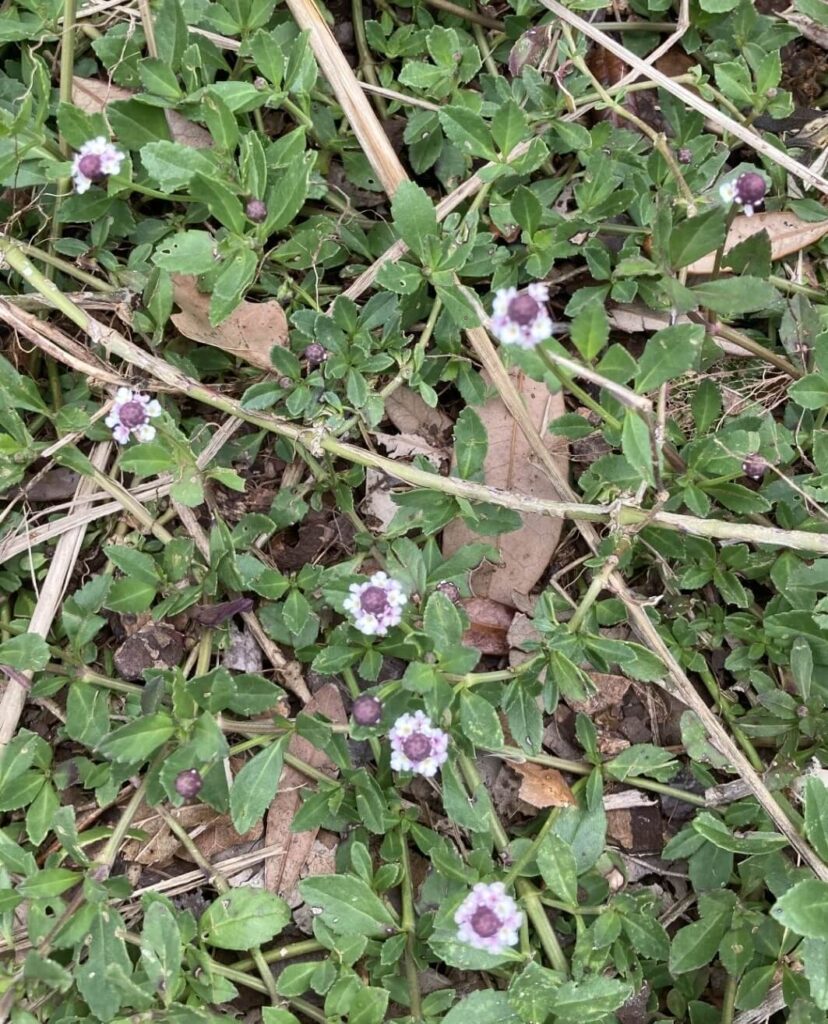
Frog fruit (Phylla nodifolia) is a low-growing native, often used as a ground cover. It is evergreen, can be walked on, and grows in sun to partial shade, moist to fairly dry soil. Frog fruit has a small bloom that attracts a lot of pollinators. And frog fruit hosts four species of Florida butterflies. In our part of Florida, the buckeye and the Phaon crescent are the butterflies that use frog fruit as a host.
Another of the October blooming native shrubs that is worth watching (and planting in a habitat garden) is salt bush (Baccharis halimifolia). With white fluffy flowers, salt bush is a salt-tolerant shrub that grows in dry or wet areas, even in brackish water. The blooms are always covered in butterflies — it is a favorite nectar plant of the buckeye butterfly.
We see buckeyes in large numbers in fall. They are named after their amazing coloration —several bright “eyes” on the top of the wings. This beautiful species of butterfly is exceptional because it has a wide range of host plants. Most butterflies have a family of plants in the same genus that they can lay eggs on and that their caterpillars can eat. Frog fruit is only one of the native host plants for buckeye butterflies. Others include wild plantain (Plantago ssp.), false foxglove (Agalinis fasiculata), twin flower (Dyschoriste oblongifolia) and wild petunia (Ruellia carolinensis). We have also found the caterpillars on non-native plants like firecracker plant (Russelia equisetifolmus) and snapdragons (Antirrhinum majus).
Buckeyes are “meadow” butterflies, meaning they are mostly seen in sunny areas with many blooming herbaceous plants. Other butterflies are “forest” species. These butterflies often have trees or shrubs for host plants, such as the spicebush swallowtail, giant swallowtail and zebra swallowtail. The zebra longwing (our state butterfly) uses passion vine as a host plant. But unlike the gulf fritillary that uses passion vine, the zebra longwings prefer to use passion vine that grows in shade to partial shade. All of these butterflies have yellow and black coloration that makes them hard to detect in partial shade. Others, like the spicebush swallowtail, have iridescent blue coloration that imitates a reflection of light.
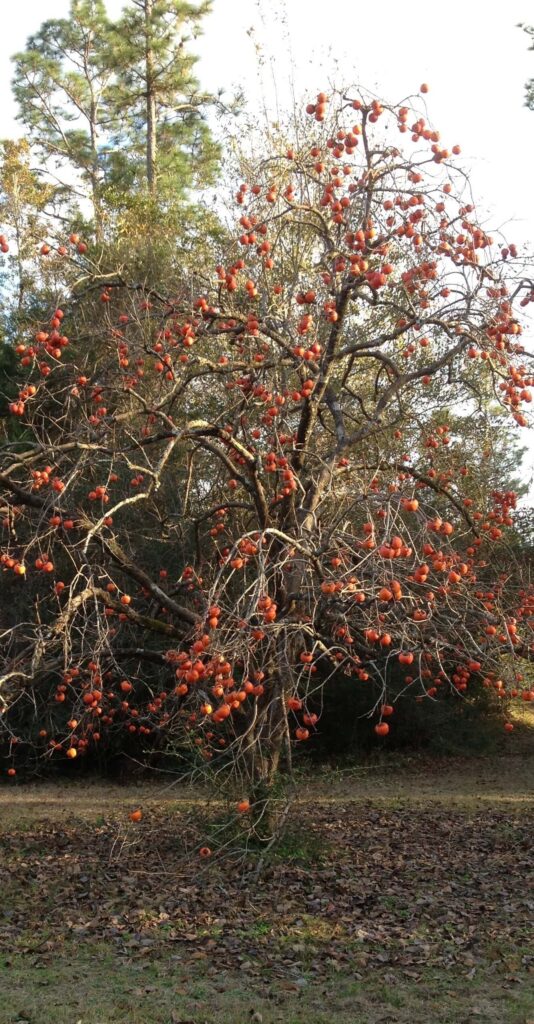
October is the traditional harvest time! Persimmons and pears have ripened over the last month (and I have been the fortunate recipient of both from friends who have fruit trees). It looks like citrus fruits will also produce a hefty harvest this year. My satsumas are green and growing, and my calamondin oranges (sometimes called Philippine orange are putting on fruit again. These citrus fruits should ripen between Thanksgiving and Christmas —just in time to add to holiday celebrations.
The calamondins look like miniature oranges. They are on the sour side but they are terrific used in citrus curd and other recipes that would call for lemon. Calamondins can produce fruit any time of the year and generally produce fruit heavily twice a year. I also like to use them in holiday arrangements and wreaths. The bright color is an eye-catching addition. The trees are easy to grow, and can reach heights of 15’ or more.

We are also having a record crop of acorns and other nuts this year, and the wax myrtles are producing loads of their beautiful blue-gray berries. Birds will have a bountiful winter!
In the veggie garden, the hot weather crops are hanging on. Field peas and okra are still producing, and I’m still getting a cucumber now and again. There is one small watermelon still on the vine and it’s a race to see if it will grow and ripen before the weather turns too cool.
As we are completing the harvest of the summer crops, it is also planting time for cool weather crops: collards, turnips, kale, cabbage, lettuce, arugula and spinach. Because we eat the leaves of these plants, we can harvest them before they are pollinated when the weather warms next spring. Root crops are also winter crops for us for the same reason — we eat the part of the plant that is produced without needing pollination. Other veggies produce flowers or buds for us to eat in the winter or early spring, like broccoli and Brussels sprouts.
Some of these seasonal plants can be quite colorful, even without blooms. Red leaf lettuces, red-veined sorrel, red mustard or kale, and Swiss chard add winter color. And because these plants can be harvested leaf by leaf, they last through the winter. A container of mixed lettuces or greens planted now can make a great holiday gift.
Herbs grown in containers can also make a great gift. Our cool weather herbs can be planted this month. Dill and cilantro are annuals that bloom when temperatures are mild. They are usually pollinated soon after. Once pollinated, the seeds are produced, and the plant’s job is done. When the seeds fall, the plant dies. A winter planting gives us several months to use these herbs. With the exception of basil, most herbs do great for us all fall and winter.

Thyme and parsley are two great culinary herbs that thrive in winter. The bright green of parsley’s leaves is a contrast with plants that are less vibrant in fall and winter. I like to use parsley in mixed containers with winter blooming plants like snapdragons and pansies — the green makes the flower colors really stand out.
Fall also gives an opportunity to save time in the spring by doing a little maintenance work now. It is a good time to pull weeds that are going to seed before they have the chance to germinate next spring. The old gardener’s saying, “One year’s seeds make seven years’ weeds” is a true expression.
The cooler weather is great for dividing perennials to increase your crop. Black-eyed Susans, Stokes’ aster, grasses and sedges are easily divided. Fall is a good time to sow seeds for hardy spring blooming native wildflowers, such as coreopsis, black-eyed Susans, and gaillardia. Fall and winter are also great times to plant trees and shrubs.
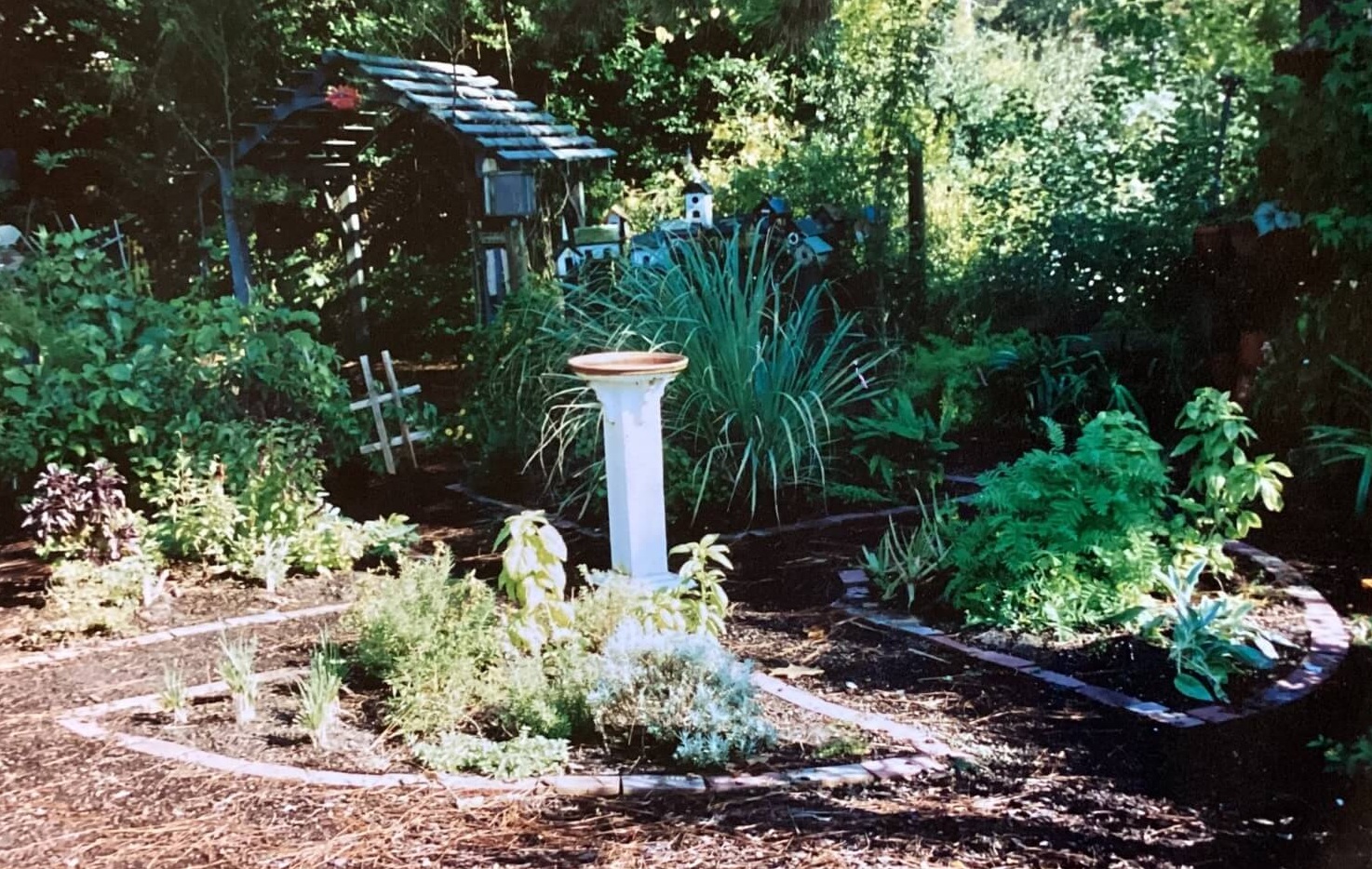
The Garden Gate closed in October of 2016. In the 19 years that we were open, and the time since, my definition of a garden has widened. In my early years, my definition was planting for production, such as food, and controlling the natural environment to my specifications. As my garden experiences gave me more and more insight, my garden definition included more and more.
Now, my definition of a garden: a garden is a relationship between people and nature. Gardeners certainly influence nature, but if we work with it, nature returns our hard work in spades. We receive food, beauty, protection, and relationship with animals, from mammals to birds to lizards, turtles, butterflies and other insects. And observing and working in the garden gives us an understanding and appreciation for the natural world, and what nature gives us back.
We have a large and active “community of gardeners” here — in community gardens and in their gardens at home. I hope you all know what an impact sharing your garden experience can bring to each other and to the community. Thank you!


and…
Happy
Halloween!!
Artwork by: Carole Simpson


Leave a Reply to Erin D. Cancel reply