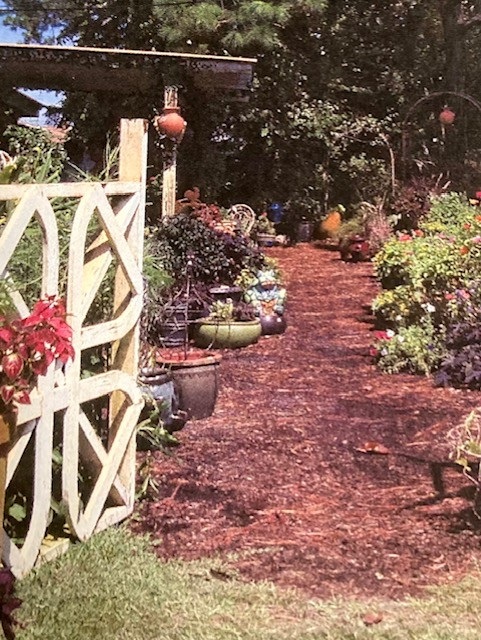
Insects and lizards actually enjoyed the astonishing heat wave of last month. The lizard population has grown exponentially — this week there is a whole new crop of baby anoles (or chameleons), both green and brown. The brown anoles, or Cuban anoles, are a non-native species introduced from the Caribbean. While there is some controversy about their presence in our landscapes, the two species seem to co-exist. At least there are both in my garden. Both are insect predators, and each species seems to stick to a territory or a layer.
Anoles lay white eggs (usually one at a time) about a 1/4” long. They look like tiny chicken eggs. We often found the eggs barely buried or covered, in a pot or other hiding place. The just-hatched lizards are tiny, but active from hatching. The anoles, both green and brown, are workhorses in the garden, always on the hunt, eating insects and keeping pest populations at bay. Right now, there are a lot of insects for a lizard feast, since insect populations increase rapidly in the heat. Lizards do an amazing job.
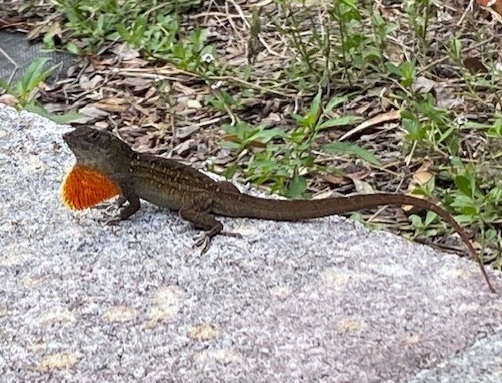
I’m sure those of you that know me will not be surprised that I “talk” to lizards. I love to talk to lizards because they seem to listen. They stand their ground and turn their head, like they are listening intently to what I say. That always makes me smile.
Actually, I talk to anything in front of me—plants and flowers, insects and reptiles, amphibians and mammals. It seems polite to acknowledge and appreciate the gifts each species brings to the garden. Naming the garden inhabitants is fun to do with children. Something about personalizing each plant or animal lets us see them from a different and more valuable perspective.
This summer, the mealy bugs have been prolific, covering plants with what looks like a mushy white “goo”. Mealy bugs are a pest insect that multiply quickly, covering the stems and leaves of a perennial almost overnight. Natural predators include lizards, lacewings and ladybugs, among others. White flies and aphids are also building pest populations. What we so often forget is that we don’t get the beneficial insects until the pest insects show up.
Mealy bugs are pretty easy to control. You can easily “squish” the mealy bugs by moving your fingers down the plant stem. Another way to control mealy bugs, white flies, aphids, and other soft-bodied insects is with soapy water. Soap acts as a desiccant, and dries out the insect bodies. Like any other substance, even mild dish soap should be used with care. Soap can dry out the plant if too much is used. It is a good idea to rinse the plant later in the day, if soap spray is used.

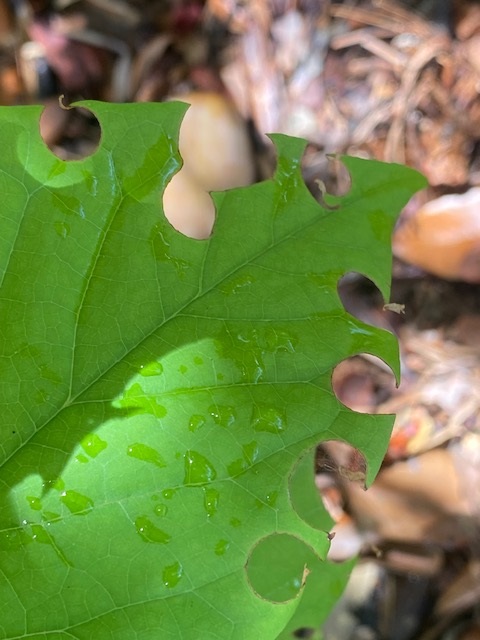
One of the most interesting pollinators that is active now is the leaf-cutter bee. A small black and yellow bee, it literally cuts leaves in a circle, choosing supple leaves to harvest. The leaf circles are folded into tube-like round chambers. Each leaf chamber holds a bee larva with pollen to feed it until maturity. Each of the larva chambers are stacked into tubes containing several chambers. The tubes are usually hidden in loose soil or leaf mulch. I have found the tubes in bags of mulch. The intricacy of the larva chambers is amazing.
Yellow seems to be the predominant flower color in the garden right now — black-eyed Susans, dune sunflower, Patrina are all at peak bloom this month. Yellow flowers attract butterflies, bees, and other pollinators that are active in the summer. Most of these yellow flowers are daisy-shaped, making it easy for butterflies to land and feed, rather than having to expend extra energy flying and eating at the same time. Some of you might not be familiar with Patrina. This long-blooming perennial has lacy yellow flowers. The long blooming flowers are always covered with pollinating insects. Sometimes there will be as many as five species nectaring at the same time.

Purple and lavender flowers are blooming or are just about to open. Tibochina ssp., (princess flower), are some of the most spectacular purple flowers blooming against pale green fuzzy leaves. Even the dwarf tibochina gets large — up to 4’, and other species get taller. The most spectacular is the big-leaf tibochina. Large fuzzy leaves, big clusters of bright purple flowers on a big plant — this plant is a focal point in the fall garden.
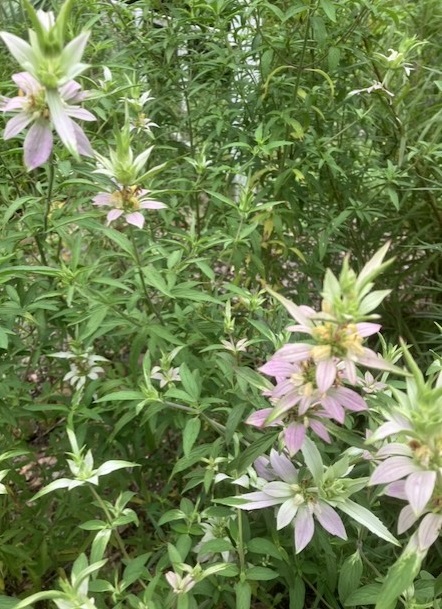
And then, there’s the horsemint! I love horsemint, and it attracts many pollinators. Horsemint is a native species of bee balm (Monarda punctata) with “stacked” flowers of lavender and pink, off-white with a few dots. The colors are subtle, but the “show” of busy insects is amazing! However, horsemint re-seeds with abandon! I have pulled up many horsemint plants this year, but you would never know it to look at my yard. My mission now is to let the pollinators collect all the nectar from the flowers, then I will pull the majority of the plants before they set seed. I have a feeling I have already lost this challenge.
More and more red flowers will begin to bloom over the next few weeks. That will coincide with the fall hummingbird migration — red is their “go-to” color. Red basil (or red calamint) (Calamentha coccinea) is a small evergreen shrub native to well-drained soil (the beach and the Gulf Breeze peninsula) with bright red trumpet-shaped flowers in the late summer and fall. Red basil does very well in my Pensacola yard, in a section that gets no irrigation. It brightens up the mostly shady area. Fire Spike is another hummingbird favorite that blooms in fall. Fire Spike is a tropical-looking perennial with large leaves and as the name implies, has tall spikes of red flowers all fall. Fire Spike will grow in sun or shade and is generally hardy. It will die back in winter but return in spring.
There are other signs of fall. The Mississippi kites that return every year to my neighborhood to mate and hatch chicks are preparing for their fall migration. The chicks have hatched and matured. I hear their beautiful call throughout the day, and watch these acrobatic birds soaring overhead. Soon the kites will migrate to their winter habitat, and they will be missed. But other birds will appear.
The hollies, sparkle berry, and beauty berry are loaded with berries, awaiting the arrival of the cool season migrating birds. The beauty berry is already beginning to change from green to the brilliant purple berries of fall. Acorns and hickory nuts are forming for other birds and wildlife to feed on over the winter. All we need now is cool weather!
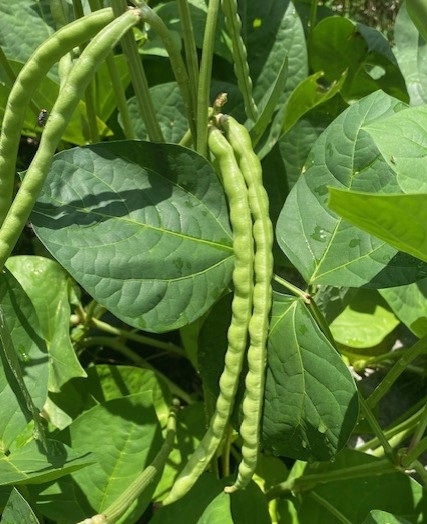
In the veggie garden my field peas are really loving this heat and so is the okra. Both are growing and producing as fast as I can pick them. By the way, black-eyed peas and zipper peas (the two varieties of field peas I am growing this summer) make excellent hummus.
Black-eyed pea hummus: Boil the peas (1.5 c) until soft, and cool. Place in a food processor or blender, and process until smooth. Add 1/3 c. Tahini, 2 Tbs. olive oil, 2 Tbs. lemon juice, 1 garlic clove. Blend, adding up to 5 Tbs. water until the consistency is smooth. If desired, top with red pepper, pine nuts or chopped pecans, or toppings of your choice.
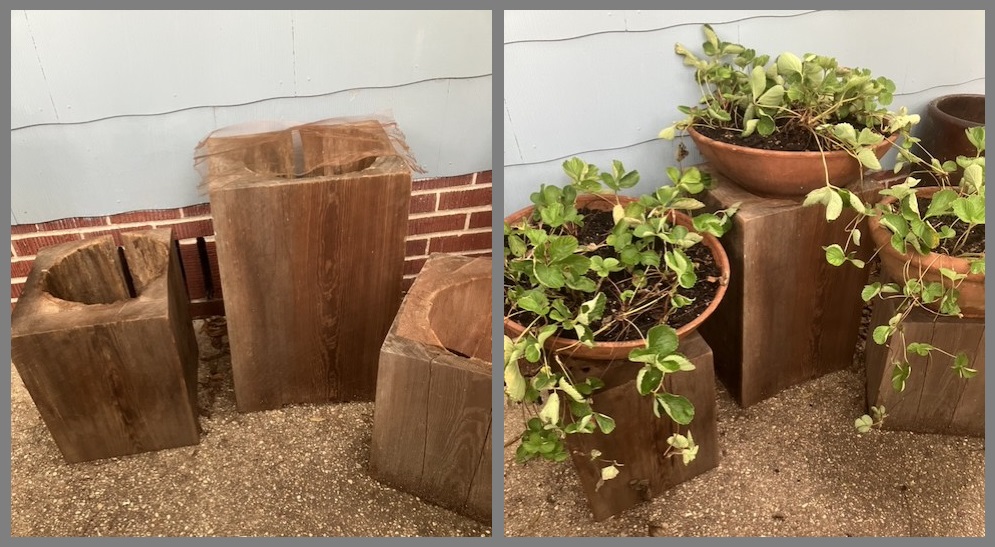
I recently bought three unique plant stands at a neighborhood garage sale. These plant stands were made in Japan to display bonsai specimens. They were brought to Pensacola by former Naval officers, and now reside in my yard. I have the perfect use for them! My strawberry plants are always trying to escape from their raised bed. Actually, that is a good thing — the “escapees’ are new plants sent out from the parent as “runners”. These plant stands will allow the runners to trail downward. I love the look of that, but it has a practical purpose too. Strawberries are beloved by slugs. But slugs don’t like to cross metal screen with the metal strands exposed. I understand that they are particularly sensitive to copper screen, because the copper produces a tiny current. I can put metal screening underneath the planter and the pot. I will let you know if this plan works to keep slugs away. I have the feeling that whether or not this anti-slug plan works, the birds will be feasting!
There are other great reasons to grow plants in containers throughout the garden. Containers and the plants in them can make an instant focal point, drawing the eye to an otherwise uninteresting area. Taller plants in containers can give instant privacy, or soften a landscape. Containers can keep plants that are aggressive spreaders in check. Passion vine and other vines are examples, as are some ground covers.
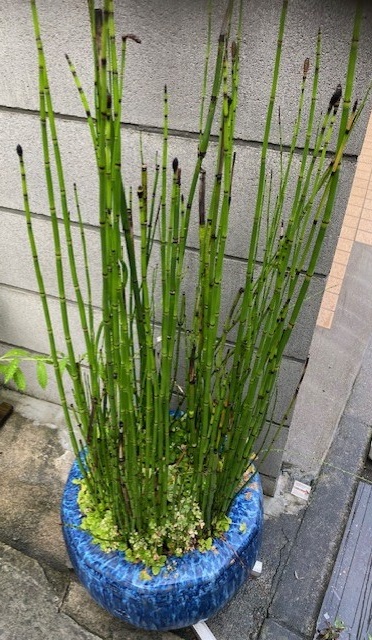
For example, I grow horsetail rush (Equisetum ssp.) in a large low pot, to keep them from spreading around the yard. This plant was given the name “horsetail” because the reed-like plant is segmented like the bones in a horse’s tail. Horsetail rush is an ancient plant that has existed on earth for 400 million years, and still grows on five continents.
This picture has potted horsetail in Tokyo, Japan.
Horsetails are such ancient species, they evolved before flowers existed and, like ferns, reproduce by spores. Usually found along stream banks, horsetail reeds have silica in their stems. Historically, people used the scratchy stems to scour dishes, — “scouring rush” is another common name for horsetails. These days, I like to cut horsetails for interesting arrangements, both fresh and dry. The green stems turn a beautiful ochre color when dried, and last for years.
Not long ago, I came across that same pattern on the shell of a young box turtle in my yard. The “spine” of the shell has an ochre stripe with black “dashes” in regular intervals. It perfectly mimicked the dried horsetail rush in my sitting room. The patterns on the other scutes looked like stylized artwork — simplified patterns like a beautiful batik fabric. Other ochre markings on the dark brown of the shell make it look like it is lit from within.
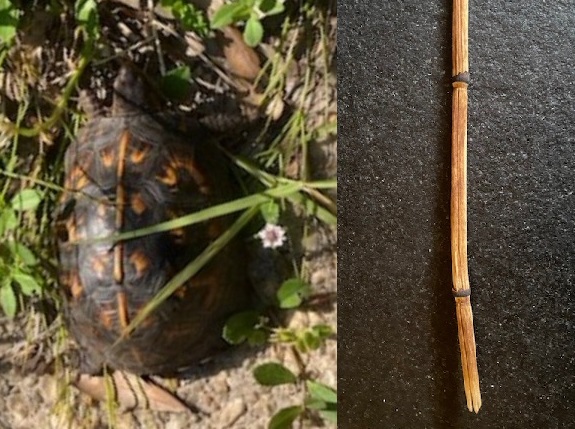
Turtles are also ancient species, on Earth before dinosaurs. They would have been likely to live in swamps or wetlands where the horsetail rush grew in abundance. I wonder if box turtles might have this coloration and pattern as a camouflage. The turtles would have perfectly blended in such an environment.
Nature’s “coloration” is so purposeful: to camouflage or blend in, or bright colors to attract a mate, dangerous looking eye-spots or “horns”; twig-like bodies to hide in plain sight! Every species is perfectly adapted to fit in its environment. The list is endless, and I never tire of looking for each unique species. I hope that you all have as much fun in your gardens as I do!
We have several events planned for next month. We are planning a garden tour of a Pensacola yard that is planted as a “food forest”. The date for this tour has not yet been set. We will be participating at the Horticultural / Environmental Seminar, presented by the Navarre Garden Club on Sept. 8th at the Navarre Welcome Center. More details will follow on this event too. On Sept. 10th, we will be presenting at the Hoe and Hum Garden Club at St. Francis Church in Gulf Breeze at 10am. The topic will be Vines and Ground Covers. Hope you will join us!



Leave a Reply